Showing posts with label british columbia. Show all posts

Thursday, 30 October 2014

No Better Place To Be


Oct 29 2014 Ladner and Brunswick Point, Roberts Bank Nature Reserve Sunny 17c

For those who live in the British Columbia's Lower Mainland the autumn and winter can bring more than a few rainy days. As I write this journal October 30th it's pouring. It's not much fun birding in the rain so when the weather forecast called for sunny breaks I decided to visit Brunswick Point via Delta's Hornby Drive.
Most of the morning was spent scoping distant flocks, looking for signs of the Pacific Golden Plover  amongst a large flock of Black-bellied Plovers. The birds were huddled together taking cover from the strong winds coming off Boundary Bay.
Because of the high tide and the accompanying swells there was very little activity on the dyke so I made my way to Ladner, taking a circuitous route to see if I could spot any raptors. Sure enough I spotted a Merlin perched atop a bush. I barely had time to jump from the car and shoot a few handheld frames before the raptor swooped away from me and nailed a shorebird (Dunlin I think)
Juvenile Merlin (Falco columbarius)
Shot from quite a distance this Merlin perches moments before making a kill.

If there were any artistic value of showing the results of the kill I would but it was gruesome. I'll leave it up to your imagination.

Next up was the Brunswick Point Tropical Kingbird that has been delighting birders and photographers with its acrobatic feeding displays. The bird which should be moving south is a rare visitor to the Vancouver area. The last sighting was two or three years ago in Delta.
This was my third visit to photograph the bird. For the first effort I took my Tamron 150mm-600mm but I found it a bit sluggish for the flight shots. To be fair I did have a few which were OK (See previous blogs for more flight shots)
This time I took my 500mm F4 and tripod and a Nikon D3s which shoots 8 frames a second and has a larger buffer for shooting raw files. Previously I used the D7100 which is a fine camera but painfully slow and has a very slow buffer hindering my ability to get more than the odd clear shot.
For better or worse here are some of the results, although not perfect they are an improvement over last week's efforts. It seems practice and patience are the only way to get better images. More about that in later blogs.
Tropical Kingbird (Tyrannus melancholicus)

A distant shot of the Tropical Kingbird about to catch an insect. The bird fed incessantly from the time I arrived until I left.


More Tropical Kingbird shots:
I can see why they are called Tyrant flycatchers, that fearsome bill would fit right into a Game of Thrones episode.

Not to be cynical but this type of shot is often called a 'Bird on a Stick' shot.
However some birds look better on a stick than others!

I dislike some of the expressions birders use, the 'Bird on a Stick' is one, the other is 'Dirt Bird' No bird deserves that moniker. 
Anyway the shot above took a lot of patience, a kickback to when I use to be an angler, camping out all night out to catch enormous carp and tench. Catch and release of course!
I would have been happy with any shot if the bird was only around for a few hours but this guy has been here for two weeks and doesn't seem too perturbed by all the attention he/she is attracting.
To find the bird on a branch that didn't have a cluttered background took hours of waiting. I additionally bisected the frame at each corner by careful cropping in Lightroom© and have left a few branches in the bottom of the frame. I think they give the image a little more of a three dimensional effect. I could have Photo-shopped them out but I don't think it was necessary or ethical. I also placed the bird in the bottom left of the frame using the tried and trusted two-thirds rule.

As I was getting carried away with the kingbird and the warm weather I 'accidentally' took this picture below. Talk about a lucky shot, it is my first American Robin flight shot. Maybe that is something to practice on with the commoner birds..Hmmm!
Maybe i'll assign myself that little project and see what I can come up with.


American Robin (Turdus migratorius)
I like this shot and that is all that matters. I like the symmetry of the wings.
There were breaks in the action when the kingbird would simply take off to catch an insect hundreds of metres away. During one such interval a Northern Harrier flew by and I was able to get off two frames.

Northern Harrier (Circus cyaneus)

Finally, when the day was coming an end a Robin perched in front of the kingbird. I thought the mixture of tones, colours and two species of birds, one common and the other a scarce vagrant an interesting juxtaposition. I quickly took two shots so that both birds would be in focus. The shot with the robin out of focus and kingbird in focus doesn't look right so i'll just remember that moment in my mind's eye and leave the memory there. The one below works better.


American Robin and Tropical Kingbird.

I've travelled around the world, visited some iconic places, met some amazing people and photographed a wide variety of creatures but honestly, it would be very hard to beat this particular day in the Lower Mainland. 


"It's never too late to start birding"

John Gordon
Langley/Cloverdale


Sunday, 9 February 2014

Further Adventures with the Canon SX50hs

Feb 9 2014 Langley B.C. Below freezing

Sometimes when I am looking for new locations to photograph I often throw my Canon SX50hs super zoom over my shoulder. I have already written about the $300 camera in previous blogs so rather than repeat myself I will post this picture of my favourite bird, the Varied Thrush. With frozen ponds everywhere in the Lower I searched for some running water where I found a flock of four Varied Thrush.
Before I started birding seriously in 2011 I was never able to get close enough to this beautiful bird to get a decent photo, in fact my attempts were dismal. Since then I have some much better shots but not the definitive image I am happy with. Most often the Varied Thrush are seen on the ground, scratching away leaves looking for food, when I saw this one on a partially frozen waterfall I couldn't pass up the opportunity to shoot a few frames on the SCENE mode.
The shot was taken handheld at the full zoom of 1200 mm. The camera has a 28-1200mm zoom with image stabilization. I recommend this type of camera for those on a budget or if carrying lots of equipment is a problem. Panasonic has similar model with a 600mm F2.8 lens but lacks the reach of the Canon. It is also twice the price but lets but in three times more light (useful in the morning and evening) and MAY have a sharper lens. I haven't used myself but have seen many in the field and everyone I spoke to likes the Panasonic.
At my workshops and presentations I often get asked by birders what type of camera to choose. It really all it depends on what results are expected. Obviously a $10,000 kit is going to more flexible albeit much heavier. For many birders if an ID shot is all that is required then either of the above cameras will do just fine.
The next level outfit is a Nikon or Canon DSLR and 300mm F4 or Sigma 150-500mm lens which you'll need to spend around $2500. Recently Tamron just released a 150-600mm lens for $1300.
Here is the picture from the Canon SX50hs from yesterday photographed on a cloudy afternoon at 3.30 p.m. I think most birders would be happy with this quality.
Varied Thrush (Ixoreus naevius)
Good Birding
John Gordon

Friday, 27 September 2013

Willet or Won't It

Sept 26 2013 White Rock, B.C. Canada. Sunny
I had heard on vanbcbirds that a Willet, a member of the sandpiper family has taken up residence on the beach at White Rock opposite the large white painted rock from which the city takes its name. Silhouetted against the late morning sun, the bird wasn't too hard to find.
I first encountered a Willet on the shores of Last Mountain Lake in Saskatchewan (see picture below)


Willet (Catoptrohorus semipalmatus) Regina Beach, Saskatchewan.


The second Willet I photographed was being chased by an American Avocet at Chaplin Lake, the Willet had the audacity to get between it and its mate.
An American Avocet chases away a Willet
(Below) During my 2013 road trip I spotted what turned out to be a Willet feeding in a fallow field near Regina Beach, Saskatchewan. I finally followed it to a watering hole for cattle where it settled down beside its mate.
A pair of Willet close to their nest.

At White Rock I made my way down as the tide was about an hour from full flood. The bird was still feeding for about 10 minutes before it hunkered down for safety with a flock of Mew Gulls.
The White Rock Willet hangs close to a flock off similar sized Mew Gulls
as a form of security.

The intricate plumage of the Willet is accentuated by photographing the bird
with a long lens and side light.
Click here for More about the Willet

Good Birding 
John Gordon

Wednesday, 27 February 2013

Rose-breasted Grosbeak/Wayward Wanderer

A vagrant Rose-breasted Grosbeak has been reported in Langley British Columbia.
Noted birder Wayne Weber writes:


" It is unquestionably a female ROSE-BREASTED GROSBEAK. This is a very rare bird in the Vancouver area--  fewer than 10 previous records, and only one of those was in the winter.
Female ROSE-BREASTED and BLACK-HEADED GROSBEAKS are quite similar and hard to tell apart. However, the Rose-breasted is more heavily streaked on the underparts, and this bird is quite clearly a Rose-breasted.

Black-headed Grosbeaks are common around here in the summer, and I’m sure you’ve seen them around your place in the summertime, but they have never been recorded here in the winter. Both Black-headed and Rose-breasted Grosbeaks are strongly migratory species which normally winter in Mexico and farther south.

Thank you so much for using eBird and for reporting this bird. The photos have sorted out the mystery of which species it was.


Saturday, 24 November 2012

Boundary Bay Birding or raking leaves!

Nov 24, 2012 Boundary Bay, Delta British Columbia. Cool and Sunny.

The big decision was to either go birding or rake the thousands of leaves lining the driveway.
By the time I arrived at the parking lot at Boundary Bay and 72nd Ave it was already full of vehicles. It was not only a glorious morning for birding or walking the dog but with the added bonus of Snowy owls that have returned for the second time in two years.
Often overlooked by the casual visitor are the Short-eared owls (see below) and the Rough-legged hawks which can be seen hovering above in the nearby fields. There are also numerous Northern harrier whose antics while hunting can be quite amusing, sometimes they even steal the prey from the Short-eared owls (see previous blog)

The one of many voles caught by this short-eared owl during an afternoon hunting session.

Short-eared owl flies away with a vole in it's talons. 
Other birds noted were Northern shrike, American robin, Yellow-rumped warbler, Song sparrow, White-crowned sparrow, Savannah sparrow, Western meadowlark, Northern flicker, Bald eagle and Snowy owl.
A Bald eagle surveys the Boundary Bay Golf course.


Yellow-rumped warbler

Sunday, 28 October 2012

Tropical kingbird a big draw and "LIFER"

The colourful Tropical kingbird first sighted at Blackie Spit Oct 21st has been a big draw for birders in the Lower Mainland. The Tropical kingbird (Tyrannus melancholicus) is a rare but regular visitor to the B.C. Coast. For the past week it could have been found easily by looking for a crowd of people with tripods and spotting scopes at the end of 104th St in Delta. It even became a family event with birders bringing their children to see the colourful yellow visitor.
Later in the day I photographed my second "Lifer" of the day a Rough-legged hawk. See following blog.
Could be sharper but.......not a bird on a stick!


The Tropical kingbird has a longer beak than does the Western.


Sunday, 9 September 2012

Pectorals, Least and Turnstones

August in British Columbia has been so warm that it was a welcome relief to head out to Boundary Bay where a cool breeze beckoned.
Flocks of Mallard and other assorted ducks use the calm waters of the bay to complete their summer moult. In some places the sand is so covered in white downy feathers that it looks like the sandy beach is covered in snow.
Along the waterline Black-bellied plovers, Sanderlings, Western sandpipers and a few Black turnstones stop over to feed and refuel before continuing their journey along the Pacific flyway to Central and South America. Some birds will cover as much seven thousand kilometres before reaching their destination. Further up the beach in small pools of brackish water trapped by earlier tides a pair of Least sandpipers dart quickly from tussock to shallow pool feeding on sand flies and other insects. The diminutive little birds freeze and crouch as a Northern harrier glides overhead, only to carry on feeding when they feel the danger has past. I spend five minutes or so with the birds, eventually they are only a few feet away.
johngordonsphotography
Least sandpiper

Pectoral sandpiper

Black turnstone

Monday, 9 July 2012

Blackie Spit (Morning Walk)

Monday July 9,2012 6.A.M.
Apart from one other early bird (excuse the horrible pun) I had Blackie Spit and the birds all to myself. The ocean was dead calm, the flood tide was about to begin and the only sounds were provided by Mother Nature herself. Above me two Caspian terns were diving for fish, a dozen black-bellied plovers, their breeding plumage beginning to fade fed on the estuary mudflats. Five Kildeer, some of them youngsters were hunting for food in the exposed eel grass while one after another, a parade of Great blue herons flew overhead, all going in the same direction to where, who knows!
I settled down to photograph Savannah sparrows and their young. I was quickly distracted by a flock of house finches feeding on seed pods, an American goldfinch flew in close enough for a quick picture, three frames and he's gone.
American goldfinch.

Savannah sparrow.

Over my shoulder I see a movement on the beach, it's a Long-billed curlew feeding in the shallows. I have to work fast before the first dog guardian/owner arrives as the bird is feeding in the off-leash area of the beach. I make myself as small as possible as I inch my way toward the waterline, slowly but surely the bird accepts my presence and continues to feed. I spend 15 minutes kneeling in the mud but it's all worth it in the end.
Good birding!!

A long-billed curlew prepares to swallow a small crab.

Long-billed curlew/Blackie Spit.


Monday, 11 June 2012

Black-throated sparrow/An irregular visitor

                                                          Grant Narrows June 11 2012


It wasn't too hard to find this rare visitor to B.C. as it was quite happy to feed right next the canoe rental office. The sparrow spent most of the time feeding on grass seeds.
A few feet away an American redstart flitted from branch to branch, perhaps in search of a mate.

Thursday, 7 June 2012

Western Birding Trip Part 3 (Yellow-breasted chat)


Although the Yellow-breasted chat has a raucous call, the bird itself is very secretive and to see one actually perch for a photograph can take a considerable amount of searching and patience. I always tell people bird photography is very similar to angling, hours can be spent just waiting for the right moment. I really think that birdwatching/photography leaves less of a "human footprint" than angling and that is why I no longer fish and have that fishy smell about me, at least I don't think I do!
A big thanks to Russell Cannings for letting me know of a reliable spot in the Okanagan Valley where this beautiful bird could be observed.

Tuesday, 17 April 2012

Elgin Park


Red-winged blackbird
American goldfinch
A small of flock of Black-bellied plover accompanied by a dozen Dunlin with both species showing striking breeding plumage feeding on the mudflats . Four lesser yellowlegs. A par of Gadwall on the inner pond. A pair of American goldfinch. A large flock of Pine siskin. Numerous Green-winged teal and Rufous hummingbirds.. A pair of House finch plus many of the usual suspects, too many and too late to list here.
Across the water at Mud Bay, a Savannah sparrow and numerous Greater yellowlegs sheltering from the cold wind. A pair of Mule deer were also feeding in the march and then on the beach.


This Mule Deer walked right in front of the camera before noticing me.

Tuesday, 3 April 2012

The Listening Bridge

After a long winter Campbell Valley Regional Park is coming back to life. Many of the resident birds are finding life much easier as caddis and other fly hatches have been occurring throughout the day. Even the song sparrows are busy feeding at the water's edge where close-by, Mallards and Ring-necked ducks are pairing up and preparing to bring their broods into the world.
Along the Little River Loop Trail a Pileated woodpecker is drumming on a snag, a Cooper's hawk glides overhead letting out a terrifying screech, below every songbird scatters and hides in the deep undergrowth, even the Douglas squirrels, wary of the danger run for cover. For minutes nothing stirs, not a sound can be heard, eventually the raptor takes off, slowly the birds return to The Listening Bridge


Black-capped chickadee

Chestnut-backed chickadee

Douglas squirrel

Fox sparrow

Oregon junco

Wednesday, 28 March 2012

Winter wrens/Campbell Valley Park


If you go down to the woods today……
Campbell Valley Park.

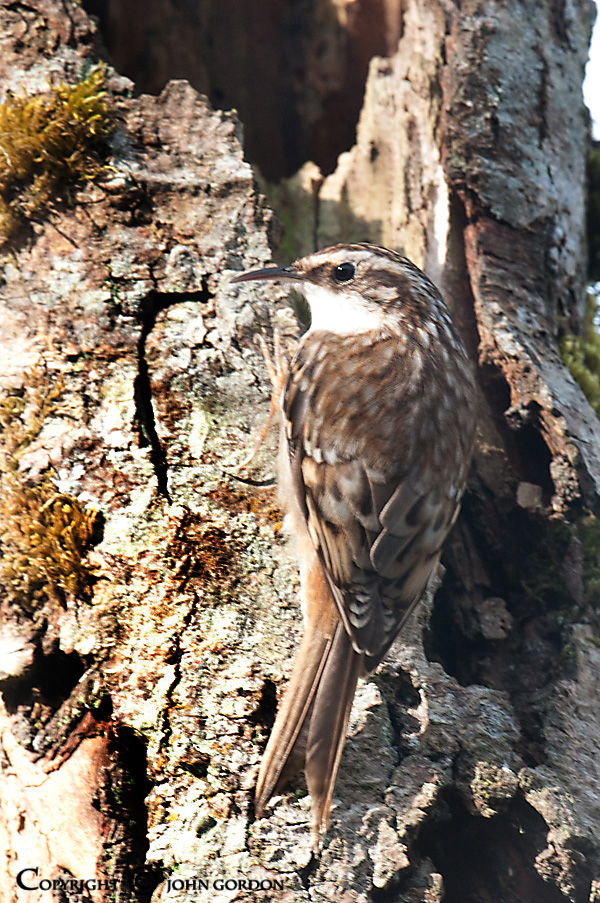
A Varied thrush flips over leaves looking for insects, a pair of brown creepers make their way up and down a pair of moss covered stumps, chestnut-backed chickadees scout for a nest site.  (See these images below)
An hour has passed and I 'm still photographing in the parking lot!
The real purpose of the days shoot was to find a Winter wren and finally nail a decent shot for my website.
 I had had success with both the Bewick's and the House wren but the diminutive and quick moving Winter wren had been a hard one to nail. 
I knew that by early spring, deep in the forest, the wrens would singing their hearts out and would be easy to locate, within minutes I had found a pair. The light on the forest floor was low so I added a little fill flash to freeze the peak action. I had to wait until the bird alighted on something with a decent foreground and background before composing and releasing the shutter. 


A few more shots from the same morning.
Brown creeper

Brown creeper

Chestnut-backed chickadee

Chestnut-backed chickadee looking for nest site

Varied Thrush (Still waiting for the perfect shot)

Sunday, 18 March 2012

Two Eagles


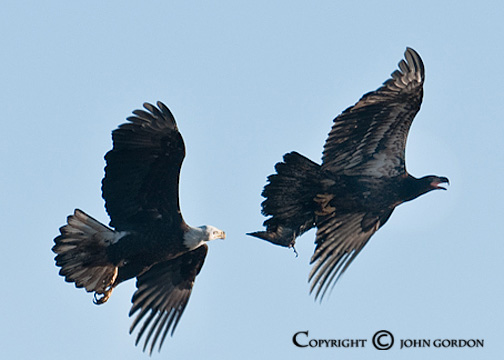
An adult Bald eagle tries to steal a fish tail from an immature.

Backyard Birding

I was just one of those days, the sun had come out after a week of rain but with the wife gone to Seattle and it fell upon me to prepare the Sunday dinner for when they got back later that evening. Don't get me wrong, I enjoying preparing food but it kinda cuts short any birding excursions planned for the day.

Unable to wander too far, I decided to pop out into the garden and shoot the Pine Siskins that had suddenly found our feeder. Beginning in December a few had visited but were driven away by our thirty or so resident House sparrows. By mid March the few December Siskins had brought back about fifty of their friends possibly because a switch of feed mix seemed to satisfy both Sparrows and Siskins. While the meal was cooking, there was just enough time to set up a portable blind, rig a few twigs for the birds to land on and voila!