Showing posts with label Lower Mainland. Show all posts

Sunday, 29 March 2015

A Lone Snowy Owl


                                Mar 25 2015 The Lower Mainland. Sunny 14c Sun and Cloud


Not where one would normally expect to find a snowy Owl.

.......but a Sharp-shinned Hawk maybe

A Sharp-shinned Hawk dive bombs the intruder. The owl being a lot bigger didn't budge.


The snowy spots something a ndprepares to take off.
A shorter lens would been better as I had little space to get a flight shot.

Two daycare workers with six children in tow ask what I am looking at. I point to large white owl on a rooftop. The wonder in those young eyes as they look toward the bird is priceless. Suddenly the Snowy flies past a flowering cherry tree and on to another rooftop.

Snowy Owl (Nyctea scandiaca)
        One of the neighbours came out to ask what I was looking at but the bird had already flown.


The house owners have asked not to advertise the location as some photographers have crossed property lines by design or by accident. Owl twitches seem to bring out the worst in some people so for the sake of the beleaguered homeowners the location is not posted here. If you are in the know then you'll know where it is.
Maybe by now this young bird maybe is already on its way back up north none the worse with its brush with suburbia.


"It's never too late to start birding"

John Gordon
Cloverdale/Langley
BC Canada

Tuesday, 16 December 2014

Tamron/Sigma 150mm-600mm Reviews


As some of you may know I have been using the Tamron 150mm-600mm for about six months. I am often asked how it performs. I have had some great results with the lens especially on long walks or when shooting out of the car window.
I have just one issue, occasionally the lens refuses to focus. I have spoken to a number of other photographers and they say the same thing. My solution is to just turn off the camera, uncouple the lens and start again. It has occured twice in six months. It hasn't caused me to lose any shots yet but it is a little discerning. I try to keep all the electrical contacts clean both on the lens and camera and hopefully the problem will vanish.


Merlin shot from 30 metres away and handheld. 

I love the lens for its compactness compared to my larger lenses, I plan to use it when I travel. Remember when handholding try to keep the lens length close to the shutter speed. For example if you are using it at 500mm then the recommended shutter speed should be at least 1/500sec. The VR function works really well so use that when needed. Remember it is harder to handhold the Tamron compared to a 300 F2.8 with a 2x or even 500mm F4 purely because of the weight factor, the heavy lens gives better balance and more stabilty.
Below I have included a link to some other reviews as well as one for the new Sigma 150mm-600mm a lens I haven't tested.
Here is a pic of a Western Tanager from a walk I took as part in with a group of birders from Langley. I wouldn't have been able to keep up with them and grabbed this shot had I had a big tripod and heavy 500mm F4 lens to carry over my shoulder. In terms of great pictures and sheer enjoyment the investment has already paid off. Try out both lenses and make your own decision, we really are spoilt for choice these days!

Enjoy!
Western Tanager Tamron handheld 150mm-600mm at 600mm


http://www.kruger-2-kalahari.com/tamron-150-600mm-lens-review.html


http://www.kruger-2-kalahari.com/tamron-vs-sigma-150-600.html


http://thecanadianwarbler.blogspot.ca/2014/05/tamron-150-600-nikon-test-run.html

"It's never too late to start birding"

John Gordon
Langley/Cloverdale

Saturday, 15 November 2014

Fraser Valley Birding


Nov 11/14 Sumas Prairie Abbotsford BC Cold 1c

American Pipit (Anthus rubescens)

Driving around Sumas Prairie in sub zero temperatures looking for raptors can be a frustrating experience. On calmer days American Kestrels, Red-tailed Hawks and even the odd Golden Eagle can make it an exciting place to bird. We did find a dark phase intermediate Red-tailed Hawk but the buffeting winds made holding the camera still somewhat of a challenge. The American Pipit (above was shot from the car window from about twenty-five metres with the Tamron 150mm-600mm. I bought the lens for situations like this when a larger lens would have been too cumbersome to set up in the cramped quarters of a small car. With no Black-backed Gull to be found we headed toward Mission to find Bald Eagles that had congregated to feed on spawned out salmon.

Varied Thrush (Ixoreus naevius)
Another car window shot with the Tamron. The lens is so light and agile it can be very useful in situations where a wary bird like the Varied Thrush can only be approached by using the car as a blind. Plus it was really windy and cold outside.


Bald Eagle (Haliaeetus leucocephalus)
An adult Bald Eagle (left) clashes with a 2nd year bird on Nicomen Slough. The spent salmon the eagles were fighting over can be seen in the water below the birds.


"It's never too late to start birding"
John Gordon
Langley Cloverdale

Thursday, 30 October 2014

No Better Place To Be


Oct 29 2014 Ladner and Brunswick Point, Roberts Bank Nature Reserve Sunny 17c

For those who live in the British Columbia's Lower Mainland the autumn and winter can bring more than a few rainy days. As I write this journal October 30th it's pouring. It's not much fun birding in the rain so when the weather forecast called for sunny breaks I decided to visit Brunswick Point via Delta's Hornby Drive.
Most of the morning was spent scoping distant flocks, looking for signs of the Pacific Golden Plover  amongst a large flock of Black-bellied Plovers. The birds were huddled together taking cover from the strong winds coming off Boundary Bay.
Because of the high tide and the accompanying swells there was very little activity on the dyke so I made my way to Ladner, taking a circuitous route to see if I could spot any raptors. Sure enough I spotted a Merlin perched atop a bush. I barely had time to jump from the car and shoot a few handheld frames before the raptor swooped away from me and nailed a shorebird (Dunlin I think)
Juvenile Merlin (Falco columbarius)
Shot from quite a distance this Merlin perches moments before making a kill.

If there were any artistic value of showing the results of the kill I would but it was gruesome. I'll leave it up to your imagination.

Next up was the Brunswick Point Tropical Kingbird that has been delighting birders and photographers with its acrobatic feeding displays. The bird which should be moving south is a rare visitor to the Vancouver area. The last sighting was two or three years ago in Delta.
This was my third visit to photograph the bird. For the first effort I took my Tamron 150mm-600mm but I found it a bit sluggish for the flight shots. To be fair I did have a few which were OK (See previous blogs for more flight shots)
This time I took my 500mm F4 and tripod and a Nikon D3s which shoots 8 frames a second and has a larger buffer for shooting raw files. Previously I used the D7100 which is a fine camera but painfully slow and has a very slow buffer hindering my ability to get more than the odd clear shot.
For better or worse here are some of the results, although not perfect they are an improvement over last week's efforts. It seems practice and patience are the only way to get better images. More about that in later blogs.
Tropical Kingbird (Tyrannus melancholicus)

A distant shot of the Tropical Kingbird about to catch an insect. The bird fed incessantly from the time I arrived until I left.


More Tropical Kingbird shots:
I can see why they are called Tyrant flycatchers, that fearsome bill would fit right into a Game of Thrones episode.

Not to be cynical but this type of shot is often called a 'Bird on a Stick' shot.
However some birds look better on a stick than others!

I dislike some of the expressions birders use, the 'Bird on a Stick' is one, the other is 'Dirt Bird' No bird deserves that moniker. 
Anyway the shot above took a lot of patience, a kickback to when I use to be an angler, camping out all night out to catch enormous carp and tench. Catch and release of course!
I would have been happy with any shot if the bird was only around for a few hours but this guy has been here for two weeks and doesn't seem too perturbed by all the attention he/she is attracting.
To find the bird on a branch that didn't have a cluttered background took hours of waiting. I additionally bisected the frame at each corner by careful cropping in Lightroom© and have left a few branches in the bottom of the frame. I think they give the image a little more of a three dimensional effect. I could have Photo-shopped them out but I don't think it was necessary or ethical. I also placed the bird in the bottom left of the frame using the tried and trusted two-thirds rule.

As I was getting carried away with the kingbird and the warm weather I 'accidentally' took this picture below. Talk about a lucky shot, it is my first American Robin flight shot. Maybe that is something to practice on with the commoner birds..Hmmm!
Maybe i'll assign myself that little project and see what I can come up with.


American Robin (Turdus migratorius)
I like this shot and that is all that matters. I like the symmetry of the wings.
There were breaks in the action when the kingbird would simply take off to catch an insect hundreds of metres away. During one such interval a Northern Harrier flew by and I was able to get off two frames.

Northern Harrier (Circus cyaneus)

Finally, when the day was coming an end a Robin perched in front of the kingbird. I thought the mixture of tones, colours and two species of birds, one common and the other a scarce vagrant an interesting juxtaposition. I quickly took two shots so that both birds would be in focus. The shot with the robin out of focus and kingbird in focus doesn't look right so i'll just remember that moment in my mind's eye and leave the memory there. The one below works better.


American Robin and Tropical Kingbird.

I've travelled around the world, visited some iconic places, met some amazing people and photographed a wide variety of creatures but honestly, it would be very hard to beat this particular day in the Lower Mainland. 


"It's never too late to start birding"

John Gordon
Langley/Cloverdale


Sunday, 9 February 2014

Further Adventures with the Canon SX50hs

Feb 9 2014 Langley B.C. Below freezing

Sometimes when I am looking for new locations to photograph I often throw my Canon SX50hs super zoom over my shoulder. I have already written about the $300 camera in previous blogs so rather than repeat myself I will post this picture of my favourite bird, the Varied Thrush. With frozen ponds everywhere in the Lower I searched for some running water where I found a flock of four Varied Thrush.
Before I started birding seriously in 2011 I was never able to get close enough to this beautiful bird to get a decent photo, in fact my attempts were dismal. Since then I have some much better shots but not the definitive image I am happy with. Most often the Varied Thrush are seen on the ground, scratching away leaves looking for food, when I saw this one on a partially frozen waterfall I couldn't pass up the opportunity to shoot a few frames on the SCENE mode.
The shot was taken handheld at the full zoom of 1200 mm. The camera has a 28-1200mm zoom with image stabilization. I recommend this type of camera for those on a budget or if carrying lots of equipment is a problem. Panasonic has similar model with a 600mm F2.8 lens but lacks the reach of the Canon. It is also twice the price but lets but in three times more light (useful in the morning and evening) and MAY have a sharper lens. I haven't used myself but have seen many in the field and everyone I spoke to likes the Panasonic.
At my workshops and presentations I often get asked by birders what type of camera to choose. It really all it depends on what results are expected. Obviously a $10,000 kit is going to more flexible albeit much heavier. For many birders if an ID shot is all that is required then either of the above cameras will do just fine.
The next level outfit is a Nikon or Canon DSLR and 300mm F4 or Sigma 150-500mm lens which you'll need to spend around $2500. Recently Tamron just released a 150-600mm lens for $1300.
Here is the picture from the Canon SX50hs from yesterday photographed on a cloudy afternoon at 3.30 p.m. I think most birders would be happy with this quality.
Varied Thrush (Ixoreus naevius)
Good Birding
John Gordon

Monday, 27 January 2014

The Falcon and the Goldfinch


Jan 23-24 2014 /Harbour Park and River Road, Ladner B.C.


Thurs Jan 23/14 Foggy with Sunny breaks

This week I had the opportunity to drop all my household chores and search out some of the raptors species that make the Lower Mainland their winter home.
As an aside, I missed having a five falcon day (no Merlin) that a few birders have had this week but four out of five ain't bad. The four falcons were the Peregrine Falcon, Gyrfalcon, American Kestrel and the Prairie Falcon.
The rich farmland in the Fraser Valley remains mostly fallow during the winter and makes excellent habitat for rodents and their avian predators. Many species of raptors arrive in the late fall from their frozen breeding grounds in the north, the prairies and the Interior. . They spend their winters in our temperate climes before returning in the early spring. Others like the American Kestrel can be found year round while the Prairie Falcon is a welcome rarity.
I started my day at Harbour Park in Ladner where exactly one year ago I photographed a White-throated Sparrow. No such luck this time but in the trees close to the car park, a flock of American Goldfinch were feeding on high protein alder catkins. The juicy insides can be seen in the bird's beak.
American Goldfinch (Carduelis tristis)
From there I made my way along River Road to see if the Prairie Falcon which was still spending its day chasing down Northern Harriers and stealing their food, it was. So far I have been quite disappointed with my efforts to get a definitive shot. Some would say it's all down to operator error! I'd heartily agree as I am finding bird photography both enjoyable and very challenging.


I spent a couple of hours trying for another chance but I can honestly say I am still searching for a definitive 'keeper' shot. Until then here goes.

A Prairie Falcon (top) tussles with a Northern Harrier.
The falcon spends most of the day stealing the harrier's prey. This very long distance shots is far from perfect
but I think does give an idea how the birds spar for food and territory.


*************************

If you are reading this and plan to go down to photograph the falcon please respect the farmer/owners property. If you don't have a long lens then stay on the road and use a scope or bins. If you are hoping to photograph the bird you'll need at least a 300m telephoto lens and if you are patient the falcon will eventually fly closer, especially in the afternoon.
Good Luck and be nice to the farmer and his wife, they are both elderly and deserve our respect even though they don't get what all the fuss is about.
It just isn't fair for the birding community to be blamed for the bad manners of a few who are spoiling what should be a positive experience for everyone. PLEASE STAY OUT  OF THEIR DRIVEWAY.


Prairie Falcon (Falco mexicanus)


Wednesday, 13 November 2013

Great Egret: The One That Almost Got Away

Oct 21 2013 Grant Narrows, Pitt River Maple Ridge B.C.
I had been so busy shooting an ad campaign for Parks Canada and Coast Cranberries that I forgot to post this very long distance image of the Great Egret. On the subject of birds I also photographed John Cleese at the Vancouver Club, he never mentioned anything about parrots, dead or resting! He did however manage to insult everyone in the room especially the lawyers and accountants who had paid mega dollars to hear him.
Anyway back to the Egret. When it turned up at nearby Grant Narrows a few weeks it was too tempting not to go and see it. Finding time and some blues skies was the biggest hurdle.
There it was, hundreds of metres out feeding on fish or perhaps frogs. Great blue Herons out numbered the great white bird ten to one. If only it would fly closer in, eventually it did but not before the sun rose and without enough shutter speed all I had managed were a series fuzzy pics, destined for the delete button. This shot was taken as soon as the sun came out and before too many dog walkers frightened the bird off. I have seen some excellent shots (which this isn't) from other photographers and I salute their dedication and skill as well as a little luck that played a part in their success. Here is my token contribution, an ID shot but cool bird anyway.
Great Egret (Ardea alba)

Saturday, 12 January 2013

White-winged crossbills (Burnaby Lake)

Jan 10 2013 Burnaby Lake, Burnaby, British Columbia
In the Vancouver area the White-winged crossbill is normally found at higher elevations where it feeds on the conifer seeds of the Western hemlock and Spruce. For whatever reason a flock of perhaps 30-40 of these colourful birds have spent the past month or more at Burnaby Lake, a lowland lakeside location where they are very rarely or if ever seen. The flock was spotted during the Audubon Christmas bird count and may have otherwise been overlooked.
As normal with rare or unusual bird sightings, scores of birders and photographers have been trudging alone the trails at the base of Piper Ave to view the birds. For many of us the bird is a "Lifer" which with the Bramble earlier in the day made it two for the day.
I hope the birds stay around for a few more days as I hope to get some better images as these were taken from quite a distance.
Adult male White-winged crossbill (Loxia leucoptera)
Adult female


Wednesday, 31 October 2012

So Many Sandpipers!

Oct 30, 2012 Pouring rain.
Who knew there were so many types of Sandpipers, ninety four world-wide. To the casual observer (non birder type of person) there is little to tell one Sandpiper from another but to the skilled observer tell tale markings like leg colour, shape or length of beak or habitat are some of the clues needed to differentiate one from another.
This year, with the help of a number of birders I have learnt to locate, identify and photograph a number of the Sandpiper family. They include the Stilt, Pectoral, Sharp-tailed, Least, Solitary, Spotted and Western Sandpipers, Long-billed curlew, Marbled godwit, Black-turnstone, Sanderling, Dunlin, Willet, Greater and Lesser yellowlegs, Long-billed and Short-billed dowitchers, Wilson's snipe, Wilson's and Red-necked phalarope.
Today I added the Rock sandpiper to the list, thanks to fellow birder Tak who phoned Raymond and I who had retreated to McDonald's to have a  coffee and warm up. The three of us found the birds on the ferry causeway http://en.wikipedia.org/wiki/BC_Ferries during a typical B.C. downpour.
Rock sandpiper was feeding with a flock Black turnstones


Preening
It would have been easier to to say home on this grey and cloudy day but I am glad I didn't. Maybe there will be chance to go back when there is some 'Sweet light' but for the moment I'm just happy to have seen this bird for the first time.

Monday, 9 July 2012

Blackie Spit (Morning Walk)

Monday July 9,2012 6.A.M.
Apart from one other early bird (excuse the horrible pun) I had Blackie Spit and the birds all to myself. The ocean was dead calm, the flood tide was about to begin and the only sounds were provided by Mother Nature herself. Above me two Caspian terns were diving for fish, a dozen black-bellied plovers, their breeding plumage beginning to fade fed on the estuary mudflats. Five Kildeer, some of them youngsters were hunting for food in the exposed eel grass while one after another, a parade of Great blue herons flew overhead, all going in the same direction to where, who knows!
I settled down to photograph Savannah sparrows and their young. I was quickly distracted by a flock of house finches feeding on seed pods, an American goldfinch flew in close enough for a quick picture, three frames and he's gone.
American goldfinch.

Savannah sparrow.

Over my shoulder I see a movement on the beach, it's a Long-billed curlew feeding in the shallows. I have to work fast before the first dog guardian/owner arrives as the bird is feeding in the off-leash area of the beach. I make myself as small as possible as I inch my way toward the waterline, slowly but surely the bird accepts my presence and continues to feed. I spend 15 minutes kneeling in the mud but it's all worth it in the end.
Good birding!!

A long-billed curlew prepares to swallow a small crab.

Long-billed curlew/Blackie Spit.


Saturday, 21 April 2012

A New Bird

Friday April 20th 2012
My first visit to Maplewood for six months. The new bridge construction on Hwy 1 makes for a torturous drive from Cloverdale so I prefer to go where there is less congestion.
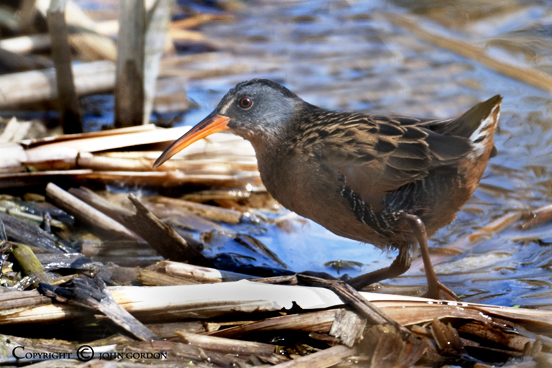
Anyway, the highlight of the day was my first sighting of a reclusive Virginia rail which was kindly pointed out to me by a fellow birder (Melody). I would have never seen it as I was so pre-occupied by the flock of Ruby-crowned kinglets that were flittering from tree to tree.
Ruby-crowned kinglet

Virginia rail

Eventually I did get a few shots of both plus a yellow-rumped (myrtle) warbler.
Male Yellow-rumped warbler (Myrtle)

Earlier I came across a flock of Red crossbill feeding on algae like seaweed. A pair of pine siskin were also feeding on the material (see the not so great picture)
Pine siskin feeding on seaweed

Red crossbills feeding on seaweed at Maplewood

Follow the link to learn more about Maplewood:

httpp://birdinginvancouver.wordpress.com/site-guides/maplewood-conservation-area/