Showing posts with label avian. Show all posts

Thursday, 28 July 2022

The Narwal: Extreme Heat and Habitat Loss

 July 28 2020 


Extreme heat a strain for birds already burdened by habitat loss
Habitat conservation and action on climate change are needed to lessen threat to at-risks species.


See story in the The Narwal which used my Red-breasted Sapsucker and Merlin images.


This Merlin had two hungry offspring to keep happy.

Click on the link below


 The image below was not used as the Narwal magazine format is for landscape rather than vertical. The vertical shot below would make a perfect cover shot. Don't forget to leave room the magazine's name and inside contents. 


"It's never too late for deadlines"
John Gordon Photography
Langley/Cloverdale
BC. Canada


Thursday, 7 October 2021

Flatiron

 Friday Sept 24 2021

Flat-out on Flatiron.

Granite slabs are scattered everywhere on Flatiron. The nooks and crannies in the rock harbour insects and plants, the flowers and seeds providing a rich food source for the many inhabitants.

Flatiron gleams in the sunlight

The forest trail to Flatiron was steep, rocky, slippery and wet. There was hardly a sound in the forest, just the odd Chestnut-backed Chickadee and Douglas Squirrels. Mushrooms were abundant. A few pickers were out collecting. After a two kilometre hike the forest opened up providing 360 degree views of the surrounding mountains. 

Yak Peak and mountain pond.


During the summer there had been numerous reports of Northern Pygmy Owls, Mountain Chickadees, White-winged Crossbills and White-tailed Ptarmigan, all birds I needed for my Fraser Valley Big Year* 
 Craig, my hiking companion for the day soon picked up the call of a Northern Pygmy Owl. Fortunately we were able to climb a little higher until we stood on the same level as the bird which was perched right above the trail.

Northern Pygmy-Owl

Then to our surprise a second owl perched alongside. The birds had their eyes on something, they seemed agitated. One of the birds plunged into the undergrowth and out of sight, looking back the other owl had left too. What a start to the day.

 Moments later they were gone.

 We continued upward, my legs turning to putty and heart racing, my lack of fitness leaving something to be desired. Five minute breaks were the order of the day. Climbing higher a flock of White-winged Crossbills were feeding on Sitka Spruce cones. They stayed long enough for a few photographs.


White-winged Crossbill.


Crossbills pry open the cones with their powerful bill and extract the seeds. 

 Eventually we reached the monument and a fork in the trail. Needle Peak to the left and to the right Flatiron and hopefully the Ptarmigan. We were still 1.5 km away. When we arrived there were already a few hikers and swimmers cooling off in the lake but alas no Ptarmigan. A flock of birds flew overhead, they sounded like Gray-crowned Rosy-Finch but I couldn't make them out or get an ID picture.


Craig takes in the view with Flatiron in the middle distance. 


 Craig decided to make his own way up the granite strewn escarpment. I waited below. Eventually through my binoculars I could see by his stance he was photographing something, probably the Ptarmigan. It was time for me to move.

 A climb from the lake to the summit took another twenty minutes. 

Suddenly my legs came to life, the energy that had been drained away on the hike had miraculously returned. Soon I was within metres of the summit and the radio tower. That last scramble was a 167 m gain but well worth it. As I reached the summit my heart was beating so hard I couldn't hold the camera still, especially a 500 mm.  I waited a few moments before firing off a few frames in case the Ptarmigan decided to take off on me. They didn't. 
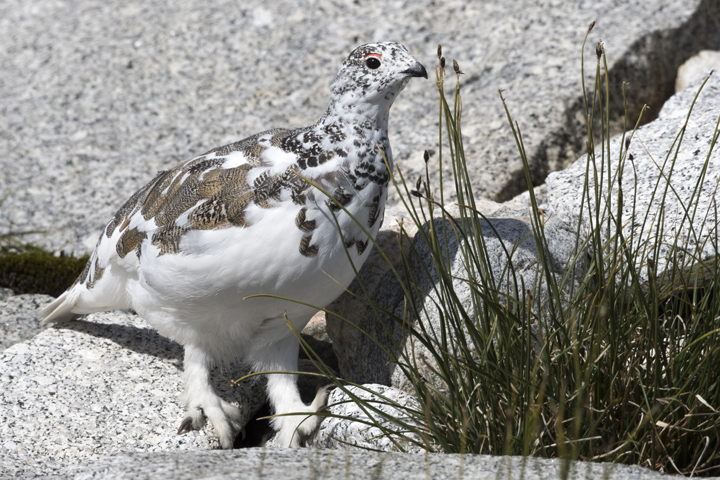
The master of disguise.

Among the tangle of rocks a slight movement gives away an elusive White-tailed Ptarmigan. 


The Ptarmigans's plumage is a perfect defence against aerial predators.

The perfect camouflage.  


Eventually we counted twenty-five or more Ptarmigan, most were hidden in cracks or in the shade of the rocks, yet others nibbling on a type of sedge. Their presence became apparent only when they moved. 


Once the birds realized we posed no threat the covey came out to feed.


There was plenty of vegetation between the outcrops.

At this point I wish I had brought my Nikon 200mm-500mm F 5.6 zoom rather than my fixed 500 mm F5.6 prime. While Craig was able to stand in one spot and compose his photographs I had to back up. A zoom would have been a better option, albeit heavier. 
I used a CCS G3 Cotton Carrier camera and binocular harness with the 500 mm on my chest and my binoculars on the side. During the hike I hardly noticed their presence except when I needed to shoot. I've photographing for forty years and it has proven to be the very best carrying system I have ever used.


Part of the  covey.


We reached an elevation of 1898 m with a combined elevation gain of 867 m from the car park. Eventually it was time to leave and make our way back down the mountain. The Ptarmigan were my third year bird** for the day. 


 Needle Peak from the lake.


The walk back was filled with the most majestic views imaginable, it's been a long time since I had been hiking. I had forgotten how beautiful the mountains can be. I used my iPhone 8 to take the accompanying scenics.

 The descent I was warned could be as difficult as the accent. True to form the steep trail was a combination of wet moss and slippery granite, for me at least it was treacherous. I'm glad I carried a pole for balance.

On the decent I thought I heard chickadees. Eventually, after a bit of searching we found four Mountain Chickadee, right on the trail,  the fourth year bird of the day. I screwed up the exposure but thankfully I had shot in Raw and was able to save the picture albeit the highlights were lost. A shame really as the background was perfect.

Mountain Chickadee

A hour later were we almost back at the car. My brain and feet were completely out of sync. I was exhausted, both mentally and physically. However both the birds and scenery were well worth the effort. Who knows, I might even try another hike one day.

Established in 1986, Coquihalla Summit Recreation Area lies in the territories of the Nlaka’pamux, Sto:lo, and Yale First Nations. (Outdoor Vancouver) 


*A big year is a personal challenge or an informal competition among birders who attempt to identify as many species of birds as possible by sight or sound in any one year.

** A year bird is a new species found during a big year.


"It's never too late to take a hike"

John Gordon

Langley/Cloverdale

BC Canada


Sunday, 26 April 2015

Odds and Sods/April Birding


April has been a bit of a whirlwind so getting down to some birding and blogging has been difficult. Needless to say I have been around and about visiting Boundary Bay, Iona, Burnaby Mountain, Brydon Lagoon, Maplewood Flats and Squamish Estuary. The last two produced no photographs but not every outing produces, besides I was doing babysitting duty close to the latter, a good excuse to bird further afield.

First up is a shot from a week or two ago. I had hoped to photograph owls at dusk but it became too dark. On the way back to the car I saw this Great Blue Heron hunting in a ditch. It was quite dark but the soft light sky reflecting onto the water made for the perfect silhouette. At least I had something to show for my efforts.

Great Blue Heron (Ardea herodias)

                                                                        *******

A few days later I visited Iona Sewage Treatment plant. Only birders would willingly spent hours scouring the stinky ponds for a rare sandpiper or duck. The odours are soon forgotten when a Wilson's Snipe is spotted then a Least Sandpiper.

Tree Swallow (Tachycineta bicolour)

                                                     A Tree Swallow takes a break from hunting insects. 

                                                                         ******


One of the most difficult sandpipers to differentiate are the Greater and Lesser Yellowlegs. Seen together there are obvious differences but separately confusion can arise.

Lesser Yellowlegs (Tringa flavipes)


A pair of Lesser Yellowlegs.

The Lesser Yellowlegs (foreground) is easily differentiated from the larger Greater Yellowlegs when seen together.


"It's never too late to start birding"


John Gordon
Langley/Cloverdale 
BC Canada


Sunday, 19 April 2015

Early Morning Birding at Iona Jetty


April 20 2015 Iona Regional Park Richmond BC Sunny 17c
The alarm went off at 5 am and again thirty minutes later. The plan was to drive to Iona Regional Park to look for a Lapland Longspur that had been seen the day before. I had only ever photographed them in the Autumn so I was looking forward to seeing one in full breeding plumage.
Because I had slept in the sun was already up when I arrived. A cold wind was blowing for the north-west, I wished I had brought gloves. I made my way out to where the bird had last been seen the evening before at around the 150 marker. Numbered markers run the length of the 4km (2.5mile) jetty. It is very popular with walkers and cyclists, especially on the weekends.
A  male Lapland Longspur seems unperturbed by a passing walker.
There were only two of us on the jetty. Eventually I saw some bird movement but it turned out to be a false alarm, just a pair of Savannah Sparrows. I keep searching and finally I found my quarry, a splendid adult with rufus nape and black face.
Lapland Longspur (Calcarius lapponicus)

I continued to photograph until a few more people passed and flushed the bird. When I relocated the first bird, a female suddenly flew in and joined the male. They continued to feed on seeds before the foot traffic became distracting,  by mid-morning it was getting warm, the light harsh and time for brunch.

The female longspur holds a seed between its beak.
  1. Female (left) and male

  2.                                                             

          The Iona Jetty 


  1. On the walk back to the car the cries of Caspian Terns drew my attention. They were quite far out and high above but with the Tamron 150mm-600mm I was able to zoom in a catch a few shots. All images were taken hand held.

    Caspian Tern (Sterna caspia)

  2. American Wigeon (Anas americana)


    "It's never too late to start birding"
  3. John Gordon
  4. Langley /Cloverdale


Sunday, 12 April 2015

Various Places/Various Birds


April 10/15 Reifel Migratory Bird Sanctuary/Richmond Nature Park/Boundary Bay.


Reifel Migratory Bird Sanctuary

On arriving at Reifel we were saddened to hear the Sandhill Crane had lost both eggs. Whether they had been predated or otherwise we couldn't confirm, only that the birds had abandoned their nest. Sanctuary manager Katherine mentioned they might have another attempt to lay depending how amorous they feel.
The goal was to find a pair of Swamp Sparrows which may to may not be breeding in the Reifel's reed beds. Normally the species heads into the interior to breed so it will be interesting to see what unfolds. I almost got a clear shot but there's always another day. 
Swamp Sparrow (Melospiza georgiana)


On the way out of the sanctuary the Harris Sparrow was hanging around with the Golden-crowned Sparrows.
It's looking a bit rough as it changes into adult plumage.
Harris Sparrow (Zenotrichia querula)
Richmond Nature Park
I just felt like going to photograph some hummingbirds. The nature park has both Rufous and Anna's Hummingbirds and numerous feeders.
Anna's Hummingbird (Calypte anna)
Juvenile I think?


 Male Rufous Hummingbird (Selasphorus rufus)

Next up was the surprise arrival of a flock of Red Crossbill. They came in so quickly for a drink at a small pond that I ended up underexposing the few shots I did manage to fire off. The result grainy pix.


Male Red Crossbill (Loxia curvirosta)


Juvenile males?

Juvenile female Red Crossbill.
After all the excitement that lasted just a few minutes, it was back to the other birds where a number of species were sharing a feeder with a Douglas Squirrel.

Douglas Squirrel (Tamiasciurus douglasii)


 Male Purple Finch ( Carpodacus purpureus)

Male House Finch (Carpodacus mexicanus)


Female Downy Woodpecker (Picoides pubescens)
Great Blue Heron (Ardea herodias)


I photographed this Great Blue Heron while waiting for the Golden Eagle. If I remember right I shot it handheld with the 500mm F4 because I had just arrived and hadn't put up my tripod.

Below is a Bald Eagle shot from the same spot but this time on a tripod. I have dozens of Bald Eagle shots but this one has a little more expression in the bird's face than most.


Bald Eagle (Haliaeetus leucocephalus)
About a month ago Boundary Bay was inundated with Bald Eagles. From one spot alone a group of us counted 180 birds wheeling around in the thermals. As the weather warms the eagles slowly disperse and us birders turn our attentions to warblers, terns and shorebirds. Some of us will head to the Interior for desert and alpine species and others for the prairies to bird for grassland species.  Wherever your birding takes you I wish you the best of luck and good birding.


"It's never too late to start birding"

John Gordon
Langley/Cloverdale
BC Canada


Friday, 3 April 2015

A Warbler, A Bluebird and an Owl.

Mar 31/15 Jericho Park Kitsilano Vancouver 12c Sun and Clouds

It was almost a week since a Mountain Bluebird and Say's Phoebe drew a number of birders to Locarno Beach in Vancouver. Due to my 'VERY busy birding schedule' I missed the Vancouver Say's Phoebe,
Back from the Okanagan (see previous blog) I made my way down to find the Palm Warbler, a species not often see in the Lower Mainland. I looked forward to seeing the Kitsilano bird. My only other sighting was a brilliant male palm in Richmond Park East. That same the day, April 22nd 2012 I also photographed a vagrant Ladner Dicksissel. Quite the day!

Palm Warbler (Dendroica palmarum) and cherry blossom.


Occasionally the palm would drop an insect and swoop to the ground to pick it up.

Trying to get a clear shot with sky proved quite a challenge, this shot was one of my favourite. 

A funny thing birding, especially whenever there's a twitch, there no need to look for the bird, just head for a crowd of people staring into a tree. Many I am told are frequent visitors to their chiropractors with the dreaded 'Warbler Neck'
The diminutive Palm Warbler, weighs in at just 7 grams would be much harder to find were it not for all those eyes to help. I am not too sure who first found the palm but a huge thanks for posting your find, allowing the rest of us the opportunity to add the bird to our list. I'm sure a few of the thirty  present took time off from work...or school to enjoy watching the bird!
Who would have thought to look in those particular trees in the first place, outside an apartment block when there are acres of parkland right next door! I suppose the profusion of flowers and the protein rich pollen was the attraction for the bird. Also in the tree were a number of Pine Siskin.
************

After the palm I made my way down to nearby Locarno Beach to catch up with a very accommodating Mountain Bluebird. I had never seen them in the Lower Mainland. After photographing the bird I think I discovered why it seemed to like this particular spot. Watching the bird feed on an plentiful supply of insects I sat back and watched it come to a nearby log, it paused looked at the other photographers and then began to drink out of a small crack where rainwater had gathered following recent rains.
Mountain Bluebird (Sialia currucoides)
 Note the water drop reflecting off the bird's breast.


Occasional the bird would take flight to hawk insects and land on one of two bushes on the beach.


Locarno Beach taken with Nikon P900
See small patch of blue on the log on the right. The bluebird drank from the log and perched in these two trees before swooping down to the beach to feed on insects.


Later in the day I visited Queen Elizabeth Park, where Tulips and Daffodils and Cherry were in full bloom.  It was 20c and there wasn't much bird captivity. Bushtits making nests, Spotted Towhees, Pine Siskins, Rufous and Anna's Hummingbird were ALL I saw, very quiet indeed. I was looking for Hutton's Vireo so if anyone can help me in that endeavour, that would be greatly appreciated. There were however plenty of people enjoying the sunshine, peace and quiet. I had a picnic and watched the tourists photographing the flowers and then dozed off for a few moments.


Later in the day I spent an hour at Harbour Park before heading for sumptuous supper at the local Golden Arches. It had been a long day but more birding was ahead.

**********

Boundary Bay at dusk 7.30 p.m

Barn Owl (Tyto alba)
A strictly noctural hunter it was a privilege to see this Barn Owl land on a post preparing to hunt. It was 7.30 p.m and the light was fading fast. I had to shoot at ISO 3200 F4 1/500 sec. I used a Nikon D3s and a 500 F4 on a tripod to have any chance of a half decent flight shot. This is where the slower lens like the Tamron and Sigma 150mm-600mm lenses are just too slow. Newer Nikon and Canon cameras have incredible light gathering capabilities especially the full frame models but even when you get to 3200 ISO things begin to look a bit noisy. However, I would rather have something to show for my efforts rather than be fussy about noise and getting bogged down in technical issues. This not to say the slower lenses won't work but you are loosing 2-3 three stop min shutter speed using the above zooms and that can be critical to your success. 


The Hunter: Shot after sunset light from the sky illuminates the wings.


Another day's birding came to an end as darkness fell. With the Barn Owl my BC year list now stands at 120 species. It's my first attempt at a year list so I gives me impetus to search out new species and get know other parts of the province and when the snow melts, the rest of Canada.
It had been a long day and on the drive home the warmth from the car's heater nearly sent me to sleep and into a ditch. I must have been dreaming of that baked potato topped with melted butter  and cheese and the game of footy waiting for me on the PVR. 
At home memories of day flooded back into my mind, especially the moment earlier in the day when another birder mentioning to me how she cherished every moment of life especially when she birded, she then rambled off some Latin phrases, the only part I understood was the the bit about Carpe Diem, and on that I completely agree. 


"It's never too late to start birding"
John Gordon
Langley /Cloverdale


Management takes no responsibility wordiness and grammatical errors, the author was probably asleep in English class although to his credit did get an 'O' level in English literature.