Showing posts with label Boundary Bay. Show all posts

Tuesday, 7 April 2015

A Golden Eagle and a Murder of Crows

April 6 2015 72nd Ave Delta BC Canada

This first shot of the Golden Eagle was taken on April 1st during a short photo session before dusk. 
Juvenile Golden Eagle (Aquila chrysaetos)
As this bird matures the white patches will be replaced by an all dark plumage. 


A few days later I took about twenty shots of the same Golden Eagle being harassed by American Crows sometimes referred to as a 'Murder of Crows"
I particularly like the crow's expression on the top left. 


Finally outnumbered, the much larger Golden Eagle is driven away from its hunting grounds by a many as fifty crows. I like the symmetry of this image, each crow having a slightly different shape. Many of the crows have white markings and I'm not too sure if they are Northwestern Crows or the American Crow. 
The shot came about at dusk, when the Eagle taking it's last hunting foray of the day ran into the crows which were massing for their nightly roost.
No two days seem the same when birding, which I suppose is the what makes the pastime so interesting.  

Check out CBC's Nature of Things
April 19 2015  2 p.m 


"It's never too late to start birding"

John Gordon
Langley/Cloverdale


Sunday, 25 January 2015

Birding Boundary Bay

Jan 21-25 2015 72nd Ave Boundary Bay, Delta BC.  Sunny/Variable cloudst 7c

Who would have thought that one of the most majestic of all birds would take up winter residence in the Lower Mainland's Boundary Bay. Birders normally get just a fleeting glance. This bird is different, it has stayed around for weeks and is easily observed from a number of accessible vantage points.


Golden Eagle (Aquila chrysaetos)

With a wingspan of 80-90 inches or over two metres, the Golden Eagle will hunt over a vast area. The 72nd Ave bird has been seen to fly away until it disappears far into the distance, only to re-appear a few minutes later. It has been seen heading toward Blackie Spit, Point Roberts and River Road. Some birds have been documented to fly as much as twenty five miles to hunt. The Delta bird tends to stay close to a plentiful supply of ducks on 72nd Ave. Watching it boss around the Bald Eagles is quite interesting.

Unlike the beleaguered Long-eared Owl which seeks a quiet place to roost during the day, the Golden Eagle hunts and roosts well away from people. 
This is my third attempt to photograph it and I am beginning to get a better angle each time and perhaps with a little more perseverance and luck I might get a sharper image without having to crop so much. This is one time when a D800 with its 36.3 million pixel count would have allowed me a finer shot. However, I won't be loosing any sleep over it. Anyway, time to leave the eagle and look for some sparrows.


                                                                                 ***

A little way along the dyke a small flock of American Tree Sparrows were feeding in the bushes and shrubs. There were some stunted alders and Paper Birch as well Himalayan Blackberries for the birds to feed and find shelter from marauding Northern Harriers. 

American Tree Sparrow (Spizella arborea)

The tree sparrows were feeding on the seeds, the long catkin is from a Paper Birch. I may be wrong with my plants, so if anyone can correct me please feel free to shame online or have me sent to a Russian Gulag.


The American Tree Sparrows were soon joined by four Lincoln Sparrows, two Yellow-rumped Warblers, numerous Black-capped Chickadees and a curious Marsh Wren.
By the end of the afternoon and with the sun sliding below Point Roberts it was time to head home.

The day added three new species to my 2015 Canadian list which now stand at 83 species. It's my very first list, one photographer I know quite well rolled his eyes when he heard I was listing. I had a good chuckle with him, something about being addicted to birding! Ask me my total species and I couldn't tell you. I'l let you know at the end of the year when I have finished my cross Canada trek.
Boundary Bay in winter is home to 50,000 Dunlin, numerous species of sandpipers and thousands of waterfowl. Northern Pintail, Mallard, American Wigeon and Green-winged Teal being present in large numbers.

Same shot cropped to give a closer view of Dunlin and black-belied Plovers.


"It's never to late to start birding"

John Gordon
Langley/Cloverdale


Saturday, 3 January 2015

New Years Day Birding

Jan 1 2015 Boundary Bay. Sunny and cold 3c

Now that 2014 tucked away in the 'ye olde' memory bank it was nice to kick-start off the new year with a few hours of relaxing birding in one of my favourite locations, 72nd Ave. It is also a favourite for joggers, walkers, families, horse riders, bikers, photographers and birders.
When I arrived there were a number of photographers already set up waiting for the Golden Eagle. It was just too busy so I headed out on to the dyke pathway in search of some winter sparrows.
It's a place where a tripod and long lens attracts questions like, What can you see? What are you looking at? How big is your zoom? and without fail, are there any Snowy Owls? I think I spent as much time chatting and socializing as I did actual bird photography!
Despite all the foot traffic, hunters blasting ducks out of the sky and dogs running loose a few of the smaller bird species still hung around. In the distance a Golden Eagle could be seen chasing flocks of Northern Pintail while a flock of Yellow-rumped Warblers were flitting around on a frozen section of the foreshore. They were quite far way but I have included one record shot.

First bird up was a Lincoln's Sparrow, a species I don't see too often. I've also seen them at Brydon Lagoon in Langley

Lincoln Sparrow (melospiza lincolnii)

Next up was an American Tree Sparrow, another species that is not that common and only found in a few locations. There are three possibly more at 72nd, they seem to hang out in the same area each year with a flock of White-crowned Sparrows.


American Tree Sparrow (Spizella arborea)


Next up along the trail were a small flock of Yellow-rumped Warbler feeding on a sheet of ice. There seemed to be something on the ice that they interested in, possibly seeds from the yarrow plants now beaten down by the wind and laying on the ground.
Yellow-rumped Warbler (Dendroica coronata)

Then a noisy Marsh Wren. According Sibley's Bird Life and Behavior the Marsh Wren has been known to have as many as 219 different songs. All I know is one can usually hear the tek-tuk-tjejejejejeje before you can see it .


I look for reward to corresponding with many of you throughout the year as I travel the Lower Mainland, BC and Canada so until then I wish you a Healthy and Happy 2015.


2015 Birds so far
Cooper's Hawk
Northern Harrier
Golden Eagle
Bald Eagle
Peregrine Falcon
Lincoln Sparrow
Savannah Sparrow
Song Sparrow
White-crowned Sparrow
Northern Pintail
Mallard
Green-winged Teal
North-western Crow
Kildeer
Dunlin 
Meadowlark
Northern Flickr
North-western Crow
Glaucous-winged Gull
Ring-billed Gull
Marsh Wren


"It's never too late to start birding"


John Gordon
Langley/Cloverdale

Thursday, 1 January 2015

What a Way to End the Year

Dec 31 2014 Boundary Bay 72 St Ave, Burnaby Mountain and Grant Narrows. Cold and Sunny.


Boundary Bay 72nd Ave Delta

The day began at 6.30 a.m with a hearty breakfast and quick perusal of my 2015 horoscope. By 8.00 a.m I had picked up Raymond and were on our way to Boundary Bay. The plan was to photograph a Golden Eagle, which from Raymond's prior experience was best attempted in the early morning light. Sure enough after only ten minutes a Golden Eagle soared over us and perched on a tall popular tree about 30 metres from the road.
These pictures are as near as I could get but they are the only ones I have of this juvenile. Two years ago I was lucky enough to photograph an adult bird at Sumas Prairie so it was nice to compare the two plumages.
For those wanting to drive out to Abbotsford there are two Golden Eagles at Sumas Prairie but you may have to work little harder to find them. A Golden was also reported at Elgin Park/Stewart House although it may be the same 72nd St bird.
Golden Eagle (Aquila chrysaetos)

How lucky we were to have seen it. Suddenly it took off and was time to leave for our next location.


 A bird of almost mythical status. 


Burnaby Mountain

An hour later we were on our way (car pooling) to Burnaby Mountain where a flock of Pine Grosbeaks were ignoring the hordes of photographers as they gorged on emerging cheery buds. The bird's antics drew quite the crowd both photographers and park patrons.

Pine Grosbeak (Pinicola enucleator)


A tight crop showing off more feather detail. 

 I composed this image in the viewfinder, first locking the focus onto the bird and then moving the camera to the left so as not to cut off the tip of the cherry tree. 


Grant Narrows/Catbird Slough
Bohemian Waxwing (Bombycilla garrulous)
On the spur of the moment we decided to take off to Grant Narrows to search out the flocks of Bohemian Waxwings that had recently invaded the area in their search for a supply of berries and insects. On warmer days the waxwings can even be seen 'hawking' insects, however this day no waxwings could be found. A few Purple Finch clung upside down on Pacific Crabapples but it wasn't until we were on our way back home that we finally found a small flock of 13 perched in small tree. We patiently waited for them to come down to feed, eventually they did. At that precise moment a very noisy work truck passed by, scattering the flock. I managed this distant shot (above) which been cropped considerably.

I hadn't meant to go birding on the last day of the year but I am sure glad I did. I had originally planned a 'Top Ten' of my favourite birds or even a page of my 2014 lifers but time restraints only allows me this little ramble.

Anyway for all of you who have been following my journal I wish you all the very best of health and happiness for 2015 and of course....good birding!:

 "It's never too late to start birding"
John Gordon
Langley/Cloverdale


Monday, 8 December 2014

Monday Morning: Before the Deluge

Monday Dec 8th 2014 Blackie Spit Nature Park. 9c Overcast with sunny breaks.

The weather forecast predicted rain for the week, up to 30 cms, a month's worth in three days. However Monday morning was warm and a little sun did manage to peek through the looming storm clouds. It was perhaps the last opportunity to bird for the next few days.
The tides were high, in places flooding over the spit. Gone were the ever-present Common Loons and the Long-billed Curlew, only a few Green-winged Teal and Mallards were left to battle the waves.
Overhead six Bald Eagles sparred for partners, one with a large stick in its talons headed towards its nest. A Merlin flew past at speed. A Golden-crowned Kinglet flitted from branch to branch. A pair of crows drew my attention to a tree where in it a Sharp-shinned Hawk was eying its next meal.
Sharp-shinned Hawk (Accipter striatus)
This bird was hunting songbirds near the pump house.


I have cropped this image to lose as many of the distracting elements as possible. I have the left hand side anchored by the tree while the branch exits the frame at the top right. The bird is placed in a frame within a frame. Just some of the thought processes us photographers try to apply to our work to make it more interesting to the viewer.


House Finch (Carpodacus mexicanus)
What drew me to this bird? The delicate way it posed on the bush. The catchlight of the sun in the eye, the Pacific crabapple (Malus fusca) on which it feeds tells a story. There was no need to zoom in and lose the context.

When I first got hooked on bird watching and bird photography I had seen House Finches but never a Purple Finch. I took as many bird walks as possible including one with expert birder Larry Cowan. During one such tour I saw my first Purple. I'll never forget what Larry said to our group.
The difference he said was the Purple Finch looks like it has been "dipped in strawberry jam"


A few metres along the trail a flock of the similar looking Purple Finch, four females and one male were also feeding on the crabapples.
Male Purple Finch (Carpodacus purpureus)
This male Purple Finch has an unusual colour to it. The yellowish hue comes from shooting through a tangle of branches with the aperture wide open. There were till a few yellowish leaves left on the branches. By shooting at the largest aperture i.e. F2.8 or F4, close-by obstacles like shrubbery can be softened and almost made to disappear.
I learnt this trick when I used to shoot baseball for the newspaper. I would stand behind the fence just looking over the shoulder of the catcher and batter and focussing on the pitcher. By shooting wide open the fence wouldn't show up and it looked like there was no obstacle in my way as the pitcher threw. I would catch the ball leaving the pitcher's hand. Try this at F8 and the fence would to show. The other upside is that a wide open aperture tends to give the photographer a higher shutter speed, perfect for bird photography.
As for the photograph above, the end result is an image that I might not have thought about attempting had I not used this technique elsewhere. 
The next shot the female was in the open.
Female Purple Finch

Soon after I returned home it began to rain and rain and rain!


It's never too late to start birding!

John Gordon
Langley/Cloverdale


Thursday, 4 December 2014

Cold Snap Birding and other Musings

Dec1-2 2014 Reifel/Sumas Prairie/Boundary Bay Sunny -5c.

The Lower Mainland and Vancouver area is/was in the midst of a cold snap with night time temperatures plummeting to minus 5c. It isn't Saskatchewan yet but it's still really cold for us on the coast. During the day the warmth of the sun and cobalt blue skies made it perfect for a birding. It sure beats the grey skies and rain!

                                                                             ****

Sometimes we see another photographers personal take on the natural world and wonder why on earth we didn't see that ourselves.
That was the case last year when I saw a fantastic image of an American Coot photographed by Jim Martin. Among other photographic projects, Jim supplies most of the excellent images for the Reifel Migratory Bird Sanctuaries quarterly magazine Marsh Notes. I think the coot was on the front page but the image really spoke to me and got me thinking. The picture encouraged me to search out my own version for which I needed a frozen pond and a good stretch of cold weather.
Jim had photographed an American Coot during a similar cold snap. For his shot the Reifel ponds were frozen and there was his amazing shot showing the Coots strange looking webbed feet as it stood on the icy pond. This is something we don't often see as the coot spends most of its time in the water and the feet are often hidden.
Here is my humble take on the subject. Now thanks to Jim I am going to take more attention to what is happening in front of the lens!


American Coot (Fulica americana)
                                                                               ****

Next up was a trip to windy and bitter cold Sumas Prairie. The goal was to search out some of the numerous raptors which make their home in and around the farmer's fields each winter. The birds are spread out over kilometres of roads and farmland. They can be hard to find. Distances travelled can be high so car pooling lessens the carbon footprint, if only a little. Car pooling is something I encourage others to try as much as possible.
The first bird on the agenda was the Gyrfalcon. What a splendid name for a bird of prey, sounds like something out of a Harry Potter book. Anyway, not only did I see the Gyrfalcon hunting I and others watched in awe as a Peregrine Falcon and a Bald Eagle chased the gyrfalcon, eventually forcing it to drop its catch. Such is life on Sumas Prairie. Below is my humble effort to show two of the fastest birds on the planet in an acrobatic aerial display.
Gyrfalcon (Falco rusticolus) and Peregrine Falcon (Falco peregrinus) clash.
The blue bar on the right of the picture is an irrigation pipe.

Avery distant ID shot of a first year Dark Morph Red-tailed Hawk (Buteo jamaicensis)
Next up was a dark morph Red-tailed Hawk. This picture is taken from quite a distance but shows just enough of the colouring to correctly identify it. Red-tailed Hawks have an incredible amount of variations. Last year I photographed a Harlan's Red-tailed Hawk, a rare sub species on Sumas Prairie.


Below is a flock of two hundred Trumpeter Swans. Hard to imagine that this would have represented the entire worlds population less than fifty years ago. Hunting and lead poising decimated the population. This flock had found a field with plenty of potatoes and were busily chomping way, oblivious of the passing farm machinery.


Trumpter Swan (Cygnus buccinator)
One of the Trumpeter Swans with tag 200K. Anyone where to send this info?

After the Sumas Prairie I decided to take a break from the cold winds and try out Boundary Bay. Having photographed Great-horned and  Barn Owls last week I was lucky enough to stumble on a Long-eared Owl that had drawn the attention of a group of photographers. When I arrived the sun was still strong but a blackberry bush was casting a strong shadow across the bird making it a less than ideal shot. I decided to wait and come back when the light was waning thus softening the shadows. Below is the image just as the sun set. Shot at 3200 ISO on a tripod with the Tamron 150mm-600mm. Why 3200 ISO, a speed I normally never use? I wanted to try out the auto ISO function and that is what I got. I have the images, it looks fine plus I'm not ever going to print it so i'm happy.
Long-eared Owl (Asio otus)

The last three images were taken with the Tamron 150mm-600mm. I did a quick test shooting the same bird at 500mm and 600mm. I couldn't see any discernible difference.
The coot and Sumas Prairie shots are taken with a 500 F4 and D300s or D7100.
Short-eared Owl (Asio flammeus)


While waiting for the Long-eared I walked a few hundreds metres along the dyke. I waited until the Northern Harriers and Short-eared Owls began hunting. The owls usually come out around 3p.m. the harriers hunt all day. Again this is a huge crop of the Short-eared Owl and works well as an ID shot. 
For those thinking about moving up from just scoping to actually photographing birds. The Tamron or the Sigma 150mm-500mm or the Nikon 80mm-400mm are all good low cost options to try out  before deciding to go for one of the "Big Guns" and the associated cost and weight.


Moonrise and Yarrow/ Boundary Bay
It had been an amazing few days of birding, a week of blue skies, the birds and the weather, a real treat those of us on the Pacific Northwest.


                                                    It's never too late to start  birding"

                                                                      John Gordon 
                                                               Langley/Cloverdale

Tuesday, 28 October 2014

Boundary Bay Birding

Oct 27/2014 Boundary Bay 64th Ave. Cloudy and sunny breaks.

Afternoon session 1-4.30 p.m.

House Finch (Carpodacus mexicanus)
A common bird at feeders and at fruit trees during the Fall and winter.


The light was fading and even at 1000 ISO the shutter speed was too low to stop the movements of this tiny kinglet. I used a Better Beamer flash diffuser on a Nikon SB800 flash. The flash head was set at 50mm on my 500mm lens with 1.4 converter. The flash was dialled in at -1/3.
Ruby-crowned Kinglet (Regulus calendula)


Yellow-rumped Warbler (Dendroica coronata)
As with the previous shots of the kinglet a little flash brightened up the scene while creating a catchlight in the eye of his dainty warbler.


 The Northern Shrike (Lanius excubiter)
Sometimes referred to as the "Butcher Bird" this juvenile Northern Shrike was hunting the small birds I was photographing. The white background is the out of focus greenhouses at the end of 64th Ave.


It was almost dark when I left for home, a few drops of rain had begun to fall, the remnants of a tropical storm way out in the Pacific was about to batter the BC coastline. Driving home there were Red-tailed Hawks hunting, Snow and Cackling Geese preparing for the deluge while the recently flooded cranberry fields held hundreds of Mallard.
By the time I arrived home it was dark, the wind was whipping up the red and yellow maple leaves in the driveway. It was time for a nice cuppa, a comfy armchair and a good book.  C'est la vie!


"It's never to late to start birding"


John Gordon
Langley/Cloverdale


Wednesday, 22 October 2014

Ignoring the Weather Forecast Pays Off!


Oct 20 2014 Boundary Bay/Blackie Spit. Overcast with sunny breaks
It was supposed to be pouring rain all day!
Sanderling (Calidris alba)
I arrived at the base of Delta's 112 St flood tide. Out in the bay thousands of Northern Pintail, Mallard and American Wigeon were feeding. Keeping them company were hundreds of Black-bellied Plovers, a single American Golden Plover, numerous Western Sandpipers, Sanderlings and perhaps two thousand Dunlin.
As the tide rushed in something spooked the flock, most of the sandpipers and plovers flew off. I knew it was time to leave when a beachcomber and dog arrived on the scene. I decided to visit nearby Crescent Beach and Blackie Spit which is a only a ten minute drive away. I had heard there was a Sharp-tailed Sandpiper among the peeps.

A flock of Dunlin and a few Black-bellied Plover are spooked by a Bald Eagle but soon come back to rest.


As the tide rose a dozen Greater Yellowlegs and about 30 Least Sandpipers began to feed quite close to the pathway that leads out to the end of the spit. American and Eurasian Wigeon (possibly hybrids) joined the sandpipers to feed on the submerged grasses.

Dunlin and Least Sandpipers flock together.
Note some of the birds have yellow legs, they are the Least Sandpiper our smallest sandpiper. There is one at the top of the frame as well as a few others.


Pectoral Sandpiper (Calidris melanotos)
From a distance I thought I had found the Sharp-tailed but as it immersed into the open the speckled breast gave it away as being a pec. Better luck next time.

Marbled Godwit in flight. I'm not too sure what the other bird is, perhaps a Dunlin?

Black-bellied Plover (Pluvialis squatarola)
All in all it was a great day outdoors and had I listened to the weatherman I would have stayed home and missed out on a glorious afternoon. It was just one of those quiet days out in nature, hardly a thought to bother me, oblivious of everything except the birds. Life can be sweet at times!

"It's never too late to start birding"

John Gordon
Langley/Cloverdale

Tuesday, 7 October 2014

Ash-throated Flycatcher

Oct 2 2014 Boundary Bay 104th St Delta B.C.
I really hadn't meant to photograph the vagrant Ash-throated Flycatcher again but on my way to find some shorebirds a small gaggle of birders and photographers were actively looking for the bird so I stopped to chat. Since my first shots, the moulting process had been in full swing and the best words to describe the bird was 'ragged and worn"
Suddenly the Ash-throated suddenly popped out of the brush so I decided to see whether I could improve on the composition from my previous series of shots. My first few shots from mid-Sept the flycatcher was perched on a dead branch and the dark background. My second attempt I had it catching a darner. This time I was after better composition. The advantage of the zoom lens became apparent when the flycatcher first flew in very close to us. With the 150mm-600mm zoom I was able to compose an image in camera at around 500mm on my D7100 and come up with a completely different looking image from previous efforts.
Ash-throated Flycatcher

I am happy with results as it gives me a different perspective. The bird is completely separated from any background distractions. I use Lightroom© for editing but try not to shoot too many "same same" images once I know I have a good record shot. I suppose it goes back to the days of film when you could see a 'keeper' image through the viewfinder as the mirror flipped. I see quite a few people rattling off hundreds of shots of the same thing and wonder wouldn't their time be better spent birding  than editing. 


"It's never too late to start birding"
John Gordon
Langley/Cloverdale

Tuesday, 23 September 2014

What's Wrong With This Picture ?


Sept 20 2104 112th and Hornby Drive, Delta BC Sunny 20c

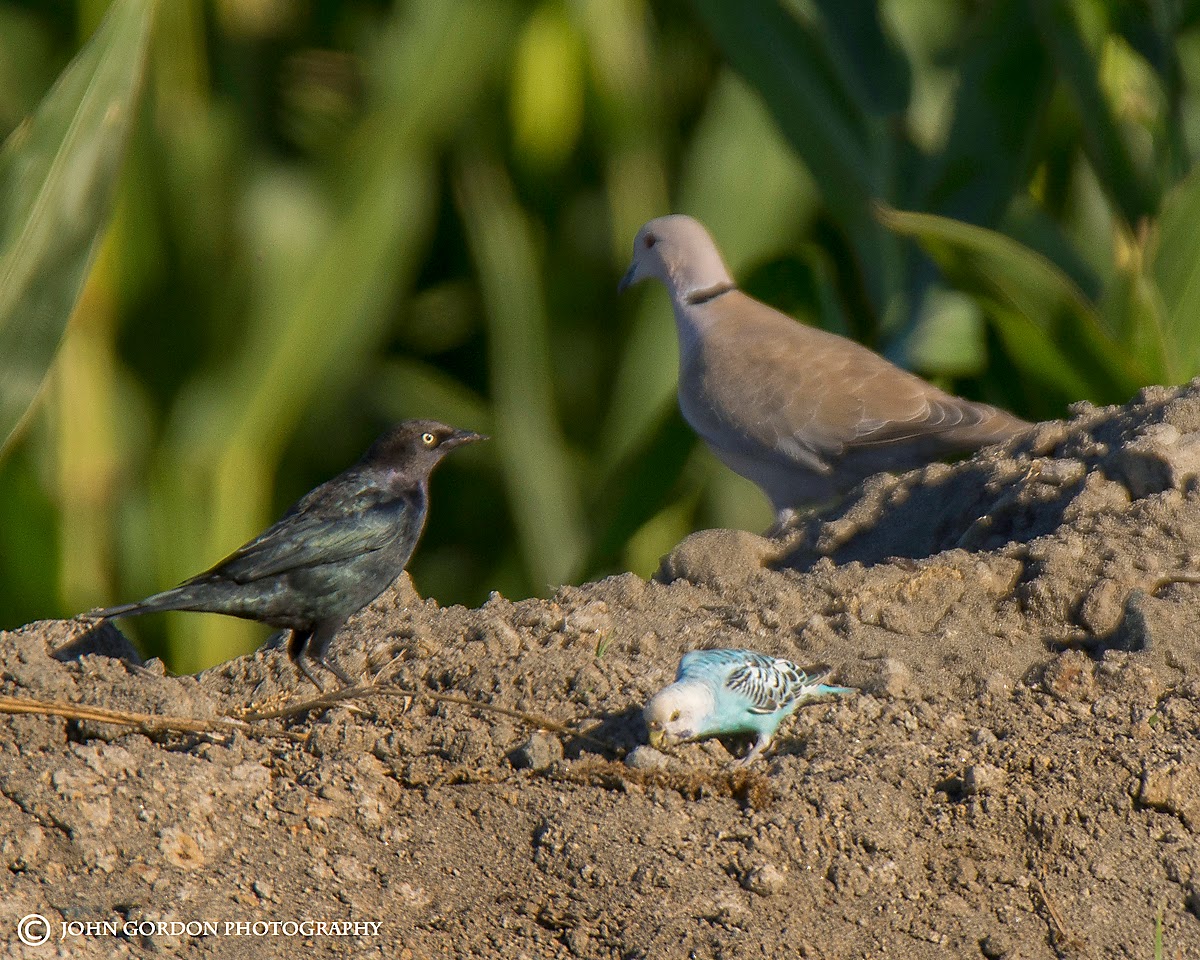
I was returning from 104th and Boundary Bay after a fruitless search for the Dusky flycatcher when at the corner of 112th and Hornby Drive a flock of Brewer's Blackbirds flew overhead. Nothing unusual about that except amongst the flock was a Blue Budgerigar. The budgie landed on a wire away from the rest of the flock, it then dropped to the ground and began to feed on the flowering fronds of corn.
Budgerigar (Melopsittacus undulates) Brewer's Blackbird and Eurasian Collared Dove.
Below is a record shot taken from one hundred metres away. All images Tamron 150mm-600mm handheld.


Although this budgie may have been caged at one point it is very wary.

"It's never too late to start birding"
John Gordon
Langley/Cloverdale

Thursday, 18 September 2014

Rare BC Flycatcher

Sep 14 2014 104 St Boundary Bay Delta B.C.
When the news of an Ash-throated Flycatcher at 104 St in Delta surfaced I decided to go down and have a look. Myself, the novice and two really experienced birders scanned every bush without much success. Finally after an hour or so the bird flew from a small fir tree onto a dead branch. It spent several minutes dispatching a darner, eventually maneuvering it head first down its gullet.
Ash-throated Flycatcher (Myiarchus cinerascens)
The Ash-throated is a larger flycatcher is rarely seen in BC, very few records exist over the last ten years so this was a special treat to all who have managed to seen it. The bird was again seen Sept  17/14. Coincidentally a few years back another flycatcher, a Tropical Kingbird also spent a few weeks at the same general location.

I like this image because of the clean background. The head looking back into the frame tells us that the bird is on the lookout for food or perhaps wary of a predator.

What a way to spend a Sunday morning!  Our never ending summer has brought all kinds of birding surprises to our doorstep and for me and many other another "Lifer" to enjoy.


"It's never too late to start birding"

John Gordon
Langley/Cloverdale

Monday, 1 September 2014

August: Out with a Roar

Aug 29 2014 Reifel Migtatory Bird Sanctuary Delta B.C
If early August birding was somewhat slow the last few days of the month certainly made up for it. At Boundary Bay I was able to find small flock of Semipalted Sandpipers, a species I hadn't seen very often. As is often the case I spent an hour winning the trust of the birds only to have them spooked by an unleashed dog.

Semipalmated Sandpiper (Calidris pusilla)
I found a small flock of Semipalmated Sandpiper mixed in with a few Western Sandpiper.
Note the shorter bill.

I only averaged of one outing a week but as August came to a close I did manage to include the Stilt Sandpipers and the Ruff or Reeve at Reifel Migratory Bird Sanctuary. The Ruff was a 'Lifer' and only the second time I had seen Stilts in the Lower Mainland. I had previously seen them in Churchill, Manitoba where they were in full breeding plumage. For more on that trip see June 2013 blog.
There were also a number adult and juvenile Sora and Virginia Rail at Reifel which delighted many who had not seen the birds before. A small flock of transient Sandhill Cranes proved very popular with visitors, especially the photographers and out of town visitors.


Sandhill Crane (Grus canadensis) at Reifiel

Sora (Porzana carolina)

There were four rails in the West Field, two Virginia and two Sora. Adults and juveniles of both species were evident. It was a quite a treat as the shy and secretive birds showed well as they fed along the pond edges.


Virginia Rail (Rallus limicola)
Ruff (Philomachus pugnax)
The female Ruff (above) is referred to as a Reeve.


Stilt Sandpiper (calidris himantopus)


On the breeding ground the adult birds use Leks in a similar fashion the grouse family.
Greater Yellowlegs (Tringa melanoleuca)

The ponds at Reifel held both Greater and Lesser Yellowlegs giving the opportunity to differentiate the two species.

Although my birding was somewhat curtailed I am lucky to have seen some excellent birds as well as meeting up with some fellow birders who I haven't seen for a while. Meanwhile I hope to keep up with the blog on a more regular basis once school is back, whenever that is!


"It's never too late to start birding"

John Gordon 
Langley/Cloverdale