Tuesday, 21 August 2018

Birds on Parade

    Monday Aug 20 2018 Harbour Green Park to Vancouver Convention Centre.

Two years in the making, the Vancouver International Festival of Birds parade was billed as "A Great Murmuration" of bird puppets. A great gathering it was, a flock of two hundred visual artists, closet birders and musicians gathered at Vancouver's Harbour Green Park for the spectacle.
  
Great Gray Owl.

Blue Heron

         The assorted flock began their migration by gleaning, pecking, mobbing (mostly dastardly crows and one Raven) flexing and fluffing their feathers. Overhead Glaucous-winged Gulls swooped and glided effortlessly over the parade, a reminder of their avian grace and agility. 
Just for a brief moment there seemed to be something special in the air and of course on the ground too. 

Whopping Crane


The flock prepares to take off.

Northwestern Crow and Tufted Puffin.

Bald Eagle 

Long-billed Curlew.

Black Oystercatcher.

 I should have brought my Sibley's, any misidentifications are my fault entirely. Here are some pictures for those who couldn't attend either because of work, distance or those unable to breath in the sooty atmosphere that had descended on Vancouver.


Ladies on a roll. 

 Made from toilets rolls, string and tape. Swarovski Optiks watch out!
Birders and  Twitchers (Birdus Twitchus)

Various species were represented by flag bearers. 

A Bald Eagle followed by Anna's Hummingbird.

Baldy the Eagle.
The majority of masks were made with papier mache, some from other household materials, many of the flock had even taken the trouble to learn bird song and calls. 

Red-tailed Hawk.

Whopping Crane close-up.


Following the march to the Vancouver Convention Centre for the opening of the Vancouver Bird Festival/Artists for Conservation Festival participants gathered to witness the unveiling of five new Canadian Post stamps featuring birds.
Opening ceremonies.

Steller's Jay and Canada Goose share the stage.

Canada Post was on site.


The Vancouver Bird Festival runs Aug19-26 in conjunction with the 2018 International Ornithological Congress 
for more information 


Thursday, 2 August 2018

Puffins and Auklets/San Juan Cruises

July 2018


San Juan Puffin watching cruises depart from the Bellingham Cruise Terminal / Alaska Ferry Terminal in Bellingham, WA.


The weather couldn't have been better. A high pressure system had stalled off the British Columbia and Washington coastline. Conditions were perfect for a boat trip, the ocean was calm and the sky cobalt blue.

Pelagic Cormorant "condo"

 Plenty of sunscreen and a wide brimmed hat were mandatory. On board the San Juan Cruise Puffin watching trip were a dozen members of the Langley Field Naturalists as well naturalists from White Rock and Delta. 

Double-crested Cormorants.
What surprised me most were the large numbers of Rhinoceros Auklets.

Most auklets were too far out of range for photography but as we neared Smith Island the boat slowed to view harbour seals making it easier to snap a few shots. 

Harbour Seal and pup.

 Rhinoceros Auklet


Most auklets were seen flying away from the boat which gave the photographers on board the opportunity to snag some flight shots, albeit from a distance. These images are highly cropped but does include a nice reflection in the water.


Heermann's Gulls out numbered Glaucous-winged and Ring-billed. During lulls in the action we looked for the odd  California Gulls that mingled with the other gull species

Heermann's Gull

         Two hours into the trip we reached Smith Island but not before viewing several colonies of         Pelagic and Double-crested Cormorants. Also present albeit in lesser numbers were Brandt's Cormorant.

Double-crested Cormorant colony

Smith Island is one of few areas left that Tufted Puffins are regularly seen in the San Juan Islands. Historically, these birds had many nesting colonies throughout the islands. However, due to population declines they have become rare and are listed as a “species of concern”.
(Courtesy San Juan Cruise website)


At Smith Island the tide was low and the Tufted Puffins were feeding in and around the kelp beds. Some young puffins were present but they stayed well away from the boat, at least it speaks of a successful breeding season. The skipper cut the motor and we drifted while we were served a delicious pasta meal.


Common Murre
The crew then decided to look for a lone male Killer Whale that had been spotted nearby. Shortly we came across a whale watching boat and from a good distance were able to observe a single male Orca  sending spray skyward. What better way to spend a day.

5 Harlequin Duck 
1 Common Loon 
5 Brandt's Cormorant 
30 Pelagic Cormorant 
50 Double-crested Cormorant 
5 Turkey Vulture 
3 Black Oystercatcher 
6 peep sp.
4 Common Murre 
30 Pigeon Guillemot 
6 Marbled Murrelet 
60 Rhinoceros Auklet 
8Tufted Puffin

More info
Puffin and Auklet watching

"It's never too late to start birding"
John Gordon
Langley/Cloverdale
BC Canada


                                                                 Bird watching cruise

Monday, 16 July 2018

Life Continues After the World Cup

Now that the World Cup is over I am back in the land of birds. Recently I was asked to supply a few minutes of video to accompany an online article advertising the IOC Congress for the Vancouver Sun.


Here is the video featuring my video of a Black Oystercatcher from Blackie Spit, Anna's Hummingbird and Green Heron fishing at Brydon Lagoon and Sandhill Cranes from Langley. There are also a raft of ducks from Tsawwassen.

WELCOME TO THE 27TH INTERNATIONAL ORNITHOLOGICAL CONGRESSVANCOUVER, BRITISH COLUMBIA, CANADA
AUGUST 19-26, 2018


http://www.iocongress2018.com

Saturday, 23 June 2018

Manning Park Bird Blitz 2018

June 15-17 Manning Park BC

The annual Manning Park Bird Blitz is an event to look forward to. The chance to bird where coastal rainforest and dry interior overlap is a special treat and being only three hours from Metro Vancouver  is a relatively short drive. There is plenty to see. Two hundred plus bird species have been recorded in the park as well as wide variety of flora and fauna.
The weekend was organized by the hopemountain.org
Please visit their site for other events.
Hermit Thrush

The bird blitz began Friday evening with an orientation and slide presentation. Friday night's speaker was Melissa Hafting (AKA Birder Girl) and Saturday Vaseaux Lake Bird Observatory (VLBO) director Sharon Mansiere. Hafting spoke about the importance of protecting the boreal forest and the many species which rely on it while Mansiere spoke about everything from climate change to bird collisions eventually bringing us all up to date on the many activities undertaken by VIBO 
Saturday attendees included many families with children along with a fair smattering of intermediate and experienced birders. It was heartening to see so many youngsters engaged in outdoor activities.
 Despite the occasional thunderstorm throughout the weekend the event went off like clockwork.


****

Saturday morning the seventy plus attendees broke into groups with the idea of covering as much of the Manning Park as possible. The organizers had chosen a dozen or more trails to explore. Each group was led by an expert or intermediate birder to aide newcomers with identification. I chose to bird Strawberry Flats with naturalist Bill Kinkaid. An all-round naturalist Bill knows his flora and fauna. Whenever the bird activity died-off he would point out plants and critters, the most striking being the four impossible to photograph Snowshoe Hares that were hopping around in a forest glade. The hares were a lifer for me.
Along the trail we began to find Canada Jays, Black-capped Chickadees, Red-breasted Sapsucker and the most common bird, the Hermit Thrush. At this higher elevation the Swainson's Thrushes were for once out numbered by their close cousin. It took awhile to tell the songs and calls apart when both birds were present.
As we made our way along the trail one of our party spotted a Spruce Grouse not more than a few metres away. Prior to the sighting we had been listening to another grouse drumming in the forest. The grouse rather than melt away into the understory drew closer to check us out. It was an awesome being so close, an experience that will be etched in my bird brain for some time to come.


Spruce Grouse
 The grouse was fearless, at one point the bird actually pecked one of the group. After spending a good ten minutes watching the bird we began to leave, only to be stopped in our tracks. The grouse was barring our way obviously upset by our intrusion. Eventually one by one we skirted around the bird, even then it continued to chase us for another twenty metres.

Spruce Grouse

We continued to find some good species, a nesting Rufous Hummingbird, a Northern Pygmy Owl, a Red-tailed Hawk and really good views of an Olive-sided Flycatcher.
Overhead were 5 Black Swifts and as we reached the ski hill we spotted both Tree and Barn Swallows. This was best place to photograph the Hermit Warblers which were perched on short pine trees next to the ski run. In the forest they were very vocal but almost impossible to see let alone photograph. A list of species seen on the three hour walk can be seen at the bottom of the blog.


After a leisurely lunch I joined another group and we birded Boyd's Meadow where the mosquitos were thick in the air. After about two kms we came to an open area where we heard a woodpecker. Soon we spotted a Three-toed Woodpecker peeling off bark and after a few minutes it briefly showed itself long enough to get the image below. We walked a little longer but the mozzies were biting through our clothing so back to the car ASAP seemed the best idea. On the way back we picked up an Osprey, a Hairy Woodpecker and a Spotted Sandpiper.

Three-toed Woodpecker.
Strawberry Flats/Manning Park
Three hours and six Kms

Dusky/Sooty Grouse 
Heard on several occasions
Cooper's Hawk 
Red-tailed Hawk 
Northern Pygmy-Owl 
Heard only
Barred Owl 
Heard Only
Black Swift 
5 birds
Rufous Hummingbird 
Red-breasted Sapsucker
Northern Flicker 
Olive-sided Flycatcher 
Willow Flycatcher 
Warbling Vireo 
Steller's Jay 
Common Raven 
Tree Swallow 
Black-capped Chickadee]
Red-breasted Nuthatch
Golden-crowned Kinglet 
Swainson's Thrush 
Hermit Thrush 
American Robin 
Varied Thrush 
Townsend's Warbler 
Wilson's Warbler 
Dark-eyed Junco 
White-crowned Sparrow 
Song Sparrow 
Spotted Towhee 


 Clarke's Nutcracker comes in for peanuts at the Lodge

"It's never too late to start birding"
John Gordon
Langley/Cloverdale
BC Canada


Tuesday, 19 June 2018

Flower Photography Workshop


Catkins/setting Sun


                                                    Workshop Description

Broaden your creative approach to photographing flowers and
the landscape they inhabit. Learn about camera techniques,
lighting, exposure settings, and how to make your photos stand
out. Bring a camera or smart phone, a 12”x12” sheet of aluminium
foil, and something to lay on. A tripod would also be helpful.

Free - RSVP required by June 20
Maple Leaves (Interpretive)


Flower and Garden Photography with John Gordon
When
Wed, June 27, 6:30pm – 8:00pm
Where
Langley Demonstration Garden, Fraser Hwy, Langley Twp, BC V3A, Canada 
Close to the Langley Airport

Monday, 18 June 2018

Late Arrivals and Misc Rumblings

 2018 Various Locations Lower Mainland BC Canada 

Campbell Valley Park the forest was alive with bird song. I quickly noted half a dozen species by sight but there were many sounds I just couldn't make out. My target bird for the day was the Red-eyed Vireo and not being familiar I played a variety of calls and songs on my iPhone to familiarize myself. Finally after a few hours in the forest I heard the call I was hoping for, then I heard it again but as much as I tried I couldn't get on the bird. Despite that I spent a relaxing morning forest bathing and listening to bird song.


***
Gray Catbird.


The Gray Catbird is very localized in the Lower Mainland, Catbird Slough and Grant Narrows in Pitt       Meadows is the best place to spot them where in a few hours I saw six. They usually arrive around mid-May.

***
One of my favourite walks is the Brydon Lagoon forested area. Most days during the winter months an Anna's Hummingbird can often be found on a single bare branch hanging over one of the pathways. During the colder months some thoughtful person takes the trouble to replenish a feeder close to where the bird patrols. I'm pretty sure this is the same bird but this time he's in full display mode, no doubt trying to attract the female of the species.
Anna's Hummingbird.
The Brydon Green Heron was so pre-occupied stalking prey it took little notice of me. It was just by the car park where a small creek flows into the retention pond. I've seen it there a number of times along with small numbers of Common Snipe.

Green Heron.

Every year a pair of Ospreys nest at the Grant Narrows. During the winter storms their regular nesting platform collapsed. The new one was erected by volunteers but has not been utilized. They're now trying to raise a brood next to a very busy boat launch. 
If that wasn't bad enough a number of photographers have been coming every day. Most have been behaving responsibly by standing back a respectable distance, others not. Those who stand back are rewarded with a shots of the male bringing food for the sitting female. Unfortunately quite a number stand way too close, forcing the male away from the nest. It is the male who brings food to the female so she can stay at the nest and incubate the eggs.
Osprey.
Eventually I lost patience and asked two female photographers to back off and sure enough they did and within a few minutes the male had returned with a fish. 


House Wrens have never been common in the Lower Mainland except for a few known regular haunts. This year there have been many more reports including several locations in Langley and White Rock. That's great news for the wrens but not so good for the swallows whose boxes are becoming increasingly populated by the wrens. A single wren will use as many as eight nesting sites to attract a suitor.

House Wren.
Richmond Park East is a seldom visited park. A breeding colony of Orange-crowned Warblers is the main draw. The Richmond Nature Park consists of 200 acres of raised peat bog habitat that once covered large portions of Lulu Island. Thankfully no dogs are allowed so one can walk without being putting your foot in you know what.

Orange-crowned Warbler.


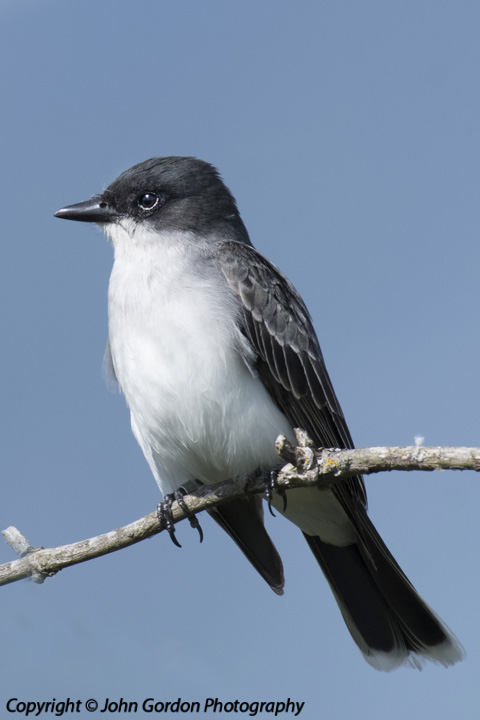
A stop off at Colony Farm turned up a pair of very confiding Eastern Kingbirds. They were first observed bathing in a ditch. If that wasn't close enough they turned up again at the duck pond but this time they flew incredibly close, an awesome experience.


Eastern Kingbird.

A few shots from under the power lines at the base of Mount Seymour. 

MacGillivray's Warbler


I spotted this Townsend's Warbler collecting what looks like dog hairs from the trail near the Mount Seymour parking lot. Birders crave good views of birds doing what birds do and this was a most satisfying look.
Townsend's Warbler
These two images of the Willow Flycatcher are the best I have ever managed of the species. I can now delete all the others so so files and free up some much needed space on my hard drives.  These images have a nice catchlight, the plumage is well defined and the background is far enough away as not to distract.

Willow Flycatcher.


All images handheld Nikon D500 and 200mm-500mm F5.6

*Since I started on this blogs weeks ago the Osprey have at least one offspring perhaps two so if you do go keep a little distance, no photo can be that important.

"It's never too late to start birding"
John Gordon
Langley/Cloverdale
BC Canada