Saturday, 23 November 2019

Tis the season for Covers

Nov 22 2019

After a thirty plus year career of publishing photographs there's still a thrill of seeing one's work published. As I have written before I cannot see the point of storing away thousands of images on a hard drive. To that end I often donate images for non-profit use or for educational purposes and are more than happy to see them used to promote the well-being of birds and their habitats.
Back in the day when I was gainfully employed I would look forward to seeing my work grace the front page, the sports and entertainment pages and occasionally provincial and national newspapers. My favourite subjects were the people involving themselves in the community. Almost a decade later the rush of being seeing one's images still lingers so when it was brought to my attention that one of my bird images had been used on the cover of Indulge I was really chuffed.
I'd like to thank Tracy Holmes for putting together such a well written and well thought-out article and that it sparks readers to get out and go birding and hopefully discover a whole new world.


Click link below for an easier to read PDF

Indulge Magazine

Front Page
A Purple Finch photographed on a bitter cold February afternoon
72nd Ave in Delta.


Inside 
Page 10


The image of the heron (above) was photographed at Tsawassen Ferry Terminal. I chose the location to take advantage of the fall colours reflected on the water. The sculpin got away. Great layout by Tracy.

Page 11

The picture below was taken on Cypress Mountain by Carlo Giovanella. The Canada Jay was a year bird for both of us. 


 Cont Page 12

******


© Black Press Community Newpapers.
Photographs © John Gordon


*****

Cover #2


The second cover appeared in BC Birding. I often supply images and copy to the quarterly publication as I know editor Clive Keen is always on the lookout for material. If you don't submit then you'll never be published. 

To see the full story about the BC Birding cover shot go to 


to 
join The British Columbia Field Ornithologists (BCFO)


Calling Birds Article


"It's never too late to be published"
John Gordon
Langley Cloverdale
BC Canada


Wednesday, 6 November 2019

How to stumble on a good bird


Nov 5 2019 

Maplewood Flats North Vancouver

How to Stumble on a Good Bird


Carlo (CAGI) and I had just spent a fruitless couple of hours enveloped in fog on Seymour Mountain. We had the crazy idea that there might be some good birds to see up there, we were mistaken. After a few hours in thick fog my extremities were frozen and I felt really grumpy, likewise CAGO was sore from a pulled muscle. Our Seymour count was precisely two Dark-eyed Juncos. Slim pickings indeed. 
We decided to head down the mountain and pop into North Vancouver's Maplewood Flats on our way home. Along the  trails the autumn colours were breathtaking but again we came up with no birds, not even a Song Sparrow. 
We were almost back to our car when we spotted a mixed flock feeding next to the wooden bridge over the creek. A couple of Ruby-crowned Kinglets, three Yellow-rumped Warblers and couple of Black-capped Chickadees. The warblers were hawking insects and the others gleaning insects from the shrubs. At first the warblers drew our attention, perhaps an elusive Palm Warbler but alas none were present. The kinglets looked a lot like kinglets but.... 

Ruby-crowned Kinglet

...one bird stood out. Small and gray, a little like a bushtit but the posture looked odd and the bill was long, could it be a gnatcatcher I thought. Before we could get an ID it flew off to a nearby tree. I managed to get a quick pic, showed it to Carlo and he agreed, it was indeed a Blue-Gray Gnatcatcher. 

Blue-gray Gnatcatcher
The gnatcatcher was the 37th record for BC


The bird was my 239 2019 Metro Vancouver and a new BC bird. 
So what started out as a day to forget became one for the record books. Suddenly my frozen parts were as warm as toast and the ride home was filled with satisfaction of another day well spent.


Previous BC sightings

The 6th for Metro Vancouver


"It's never too late in the day to find a good bird"
John Gordon (JOGO)
Langley/Cloverdale
BC Canada

Tuesday, 22 October 2019

A Mad, Mad Twitch..Twice!

Panama Flats
 Victoria 

Mon Oct 20/21 2019

 Murphy's Law Strikes Yet Again


On this occasion I was headed out of Vancouver to Squamish when an ABA Code 4 MEGA was found by Victoria birders Jeff Gaskin and Geoffrey Newell. The bird, a Yellow-browed Warbler, is a relatively common and native of Asia but very rare in N.America, it even drew a TV crew and journalists to a muddy Victoria hillside. Three days later the bird was still around drawing a steady stream of birders from across Canada and the USA, some travelling thousands of kilometres just to catch a glimpse.


The Twitch #1 Oct 20 2019

On Saturday morning determined not to miss a once in a life opportunity I drove (mostly at the speed of sound/limit) from Squamish through Vancouver to Tsawwassen to catch the 1 p.m. ferry to Vancouver Island. At 3.05 I arrived at Panama Flats where a small flock of assorted birders were looking. At dusk the bird still hadn't shown and as the sun set I made my way back to the ferry and Vancouver, disappointed and tired from the long day, a feeling I am sure every birder can sympathize with. I decided then and there to return next day. I just didn't want to spend my life's savings again so I texted Mel and asked her help to find me others who would share the cost of the ferry. Ten minutes later I had four takers for Monday morning. Carpooling also reduces the carbon footprint us birders contribute to the climate crisis.


If At First You Don't Succeed
Twitch #2 Oct 21 2019

Monday morning the alarm went off at 4:45 a.m. It was dark and raining. Soon I was on the way back to Vancouver Island but this time with a carload of birders. Onboard was one Larry, the two Marilyn's and one Mike. 
When we arrived there were fifteen or more birders on site including one of the original finders Geoffrey Newell who was kindly pointing out the bird to anyone interested. The tiny warbler was travelling with a Yellow-rumped Warbler and a Ruby-crowned Kinglet. The kinglet being the same shape and size added to the fun of trying to figure out which one to photograph. Despite the overcast skies and rain I was able to get a few shots through the foliage. I cranked up the ISO to 1250 and over exposed a stop and half and was able get a couple of frames before it was time to return to the ferry and make it home to vote. Mission accomplished. 
Yellow-browed Warbler (Phylloscopus inornatus)

As twitches go the second attempt was a resounding success making the journey home that much sweeter. Read more about it in the Victoria Times

Birders Flocking to view rare warbler


 Yellow-browed Warbler facts


Misc bird links

Loudest-bird-meet-the-white-bellbird

Magpie shot dead

"It's never too late to start twitching"


John Gordon
Langley/Cloverdale
BC Canada


Saturday, 21 September 2019

Louth and Lincolnshire 2019


THE UK
Lincolnshire
Aug 2019


 I arrived on the hottest day ever recorded in the UK (38.7C or 101.66F) and the same day Boris Johnson became prime minister.
My first night was spent at the White Hart Hotel St Albans built circa 1470, unfortunately the only hotel in town without air-conditioning. Next mornings newspaper headlines included "roads melt like chocolate and tracks buckle"
Experts say that Britain can expect more and more erratic weather systems, as if it wasn't cloudy and wet enough already!


Before I go on any overseas trip I try to contact some of the birding friends most of who I have met through the online group Birding Pals. It might be the best $10 you'll ever spend.
 See link for more info
 Birding Pals
Before I leave I check Facebook and especially Twitter feeds as they provide plenty of good information about local bird sightings. Also most counties have bird clubs who are also a valuable source of information.

 This time I touched bases with Steve and John to see if they had any ideas about what birds might be around. Last year they generously introduced me to a number of their local hotspots. The other thing I decided to do was go with just one bag of clothes, one bridge camera and a toothbrush. I took the Nikon P1000 24mm-3000mm.


My UK life list is a modest 167 so with a possible 500 plus species it stood to reasons there should be plenty of opportunity to pick-up a lifer or two.
Both John and Steve have 500 plus UK life lists and many amazing stories about chasing birds. Last year on the way to Spurn Point National Nature Reserve near Hull I sat in the backseat listening to epic twitches to the Channel and the Orkney Islands.


 I knew I wouldn't have time to bird much and as it turned out I hardly birded at all. Family always takes precedent, Dad is 93 so precious moments spent with him are all important. One day we drove to seaside and parked overlooking the North Sea, drank tea, read the newspaper and watched the birds on the beach. Offshore a few Northern Gannets flew past while on the shore Oystercatchers dodged holiday makers and their pesky dogs.
 On one cloudy morning on the way to pick-up the newspaper the sky was dotted with Swifts. The Goldfinche, my favourite bird flitted along the hedgerows, two great sightings before breakfast.


Goldfinch
Nikon P1000


***

After shaking off the effects of jet lag my younger brother Roger took me out to Red Hill Nature Reserve, a small tract of land left to its own design. I spend a blissful afternoon there listening to the  Yellowhammers calling and a Common Whitethroat collecting food for her brood. It was a perfect English afternoon.


More about the Lincolnshire Wolds

A few miles out of town is Red Hill Nature Reserve a chalky outcrop with a unique display of flowers and butterflies.

The area comprises 1.6 hectares (4 acres) of steep chalk escarpment grassland with some scrub and 1.6 hectares of old plateau grassland, and a disused quarry with a famous exposure of Red Chalk which is rich in fossils, particularly belemnites and brachiopods. Below the Red Chalk there is a considerable thickness of Carstone, here a coarse, pebbly sandstone, and above it a thin capping of the white Lower Chalk.

                                                                            Lincolnshire Wildlife Trust


Large Heath (Coenonympha tullia)

View from Red Hill
 Lincolnshire Wolds
Nikon P1000


Common Knapweed
(Centaurea nigra)


Peacock (Aglais io)


Painted Lady (Vanessa cardui)


Dad lives on the edge of town where there are a good number of Wood Pigeons, where Blackbirds sing all night long and Rooks sits atop chimney pots. Any of those birds would set off a stampede were they to turn up in Vancouver.
 Around Louth's church were the unmistakable sounds of Swifts (Apus apus) At first the birds were scattered across the sky, flying low as the church's spire became enveloped in mist. Eventually twenty of more flew in perfect formation before splaying out in all directions. Their calls rang out louder than ever as they skimmed over the row houses. What an amazing spectacle, indelibly etched in my birding memory bank. My guess is most were recently fledged, fattening up for the long migration to Central Africa.


View from Red Hill
Common Whitethroat

It is a summer visitor and passage migrant, with birds breeding widely, although it avoids urban and mountainous areas. It winters in Africa, south of the Sahara.


Yellowhammer
Previously widespread across Britain, yellowhammers are now on the "red list" of birds who are now a "conservation concern"


Finally I visited Frampton RSVP and spotted a Ringed Plover, a cousin of the Little Ringed Plover, which until I entered it into eBird didn't realize was a lifer. The other life was the Turtle Dove, the second of the trip.
Familiarity is the word here, I marvel at all the birds whenever I visit somewhere new and there really is something magical about that.
So until next time.. good birding.

"Better late than never"
John Gordon
Langley/Cloverdale
BC Canada


Saturday, 7 September 2019

Before and After


Before heading toward Golden and the annual British Columbia Federation of Ornithologists (BCFO) conference fellow birder George Clulow and myself took the opportunity to visit a few select locations on the way. Golden is a long drive from Langley so we decided to take our time. It not only broke up the driving but provided us with a variety habitats to explore at a leisurely pace.
Cheam Lake near Chilliwack was the first stop followed by an amazing mornings birding with Alan Bergen. The lakes around Merrit and Creston's Duck Lake were just a few of the places we visited. George's finely tuned ear also got me onto numerous species especially my nemesis the Veery, a bird we heard but was yet to see. A secretive species at the best of times it remained off my life list until one turned up in Fort Langley July 14. I was my 400th Canadian species and therefore a special bird, especially as they are not often encountered in the Lower Mainland.


Day 1 
Cheam Lake 

Our first stop was at Cheam Lake near Chilliwack. We had great views of an Osprey fishing, a Black-headed Grosbeak collecting grubs as well as an interesting selection of dragonflies.
Black-headed Grosbeak picking up grubs
 P1000

Osprey  P1000

Marsh Marigold leaf pattern
P1000

Eight-spotted Skimmer
P1000


Kane Valley

After Hope and an early start we made our way up the Kane Valley. We met up with a local birder who generously showed us one of his favourite spots. We walked through pastureland, flowering meadows, a small marsh and an aspen forest. There were plenty of decaying trees for cavity nesters like Mountain Bluebirds, Red-naped and Williamson's Sapsuckers. The wild grasses and open spaces were perfect for Vesper, Lincoln's and Savannah Sparrows. At the time of our visit no cattle had been sent out to graze so hopefully the ground nesters will have fledged by that time. Our almost four hour walk produced forty-seven species. 
Spotted Sandpiper

Dusky Flycatcher


Mountain Bluebird


Williamson's Sapsucker (Male)

Williamson's Sapsucker (Female)

Williamson's Sapsucker brings food to the nest.
D500 and 200mm-500mm

Merritt

We had another two stops near Merrit. First the Laurie Guichon Memorial Grasslands Interpretive Site where the usual Ruddy ducks were absent. We were however rewarded have excellent views of the resident Osprey which has been provided with a platform to nest on. There are a number of world class fly fishing lakes close by which I am sure raises the ire of every angler when they see the Osprey flying away with a fat trout. No catch and release for the avian fisher.

Osprey
 P1000

                                   Guichon Ranch - Beaver Ranch Flats

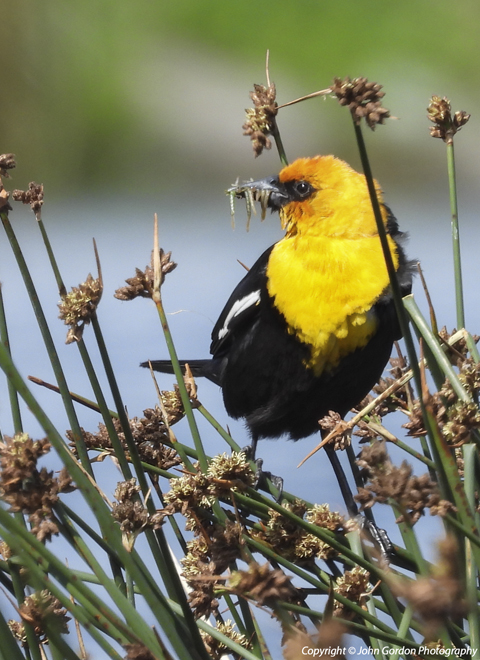
Yellow-headed Blackbird
P1000

 Logan Lake

A flat tire at Tunkwa Lake saw us making a detour to Logan Lake. Following repairs we went for lunch at the local lake where we had some really good birding along the riparian area and again in the lake itself where George spotted a Canvasback with a brood, something I might have easily overlooked.

Canvasback with some of her brood.
Nikon D500 and 200mm-500mm

They eventually got so close we both sat and enjoyed their presence.

Hybrid Red-naped Red Breasted Sapsucker
D500 Nikon 200mm-500mm

Salmon Arm

We broke the journey at Salmon Arm which gave the opportunity to bird three separate locations. We picked up new trip species at most all of them. The highlight for me a least were the two-hundred or so Black Swifts that were feeding over the lake and above our heads. I had never seen so many, the low cloud and drizzle had kept the insect hatch low enough for us to observe the birds and even grab a few pictures. Note the bird in the photograph below is an immature. 


Black Swift
Nikon D500 Nikon 200mm-500mm f5.6 


Return journey via Creston

Who could miss a big white American White Pelican. A small flock of Ring-billed Gulls and a pair of  Forster's Terns and numerous Eastern Kingbirds were just a few of the species added to our lengthy list now topping 100 species.
American White-Pelican
Not as sharp an image as I would like but handheld at 3000mm works well enough for an ID shot.


The wide angle of the P1000 at 24mm make capturing scenics a breeze. 


'Sweet Light' pours through the folds of mountains to the west. On closer inspection were various species of ducks including Blue-winged Teal were found foraging round the lake edges. 

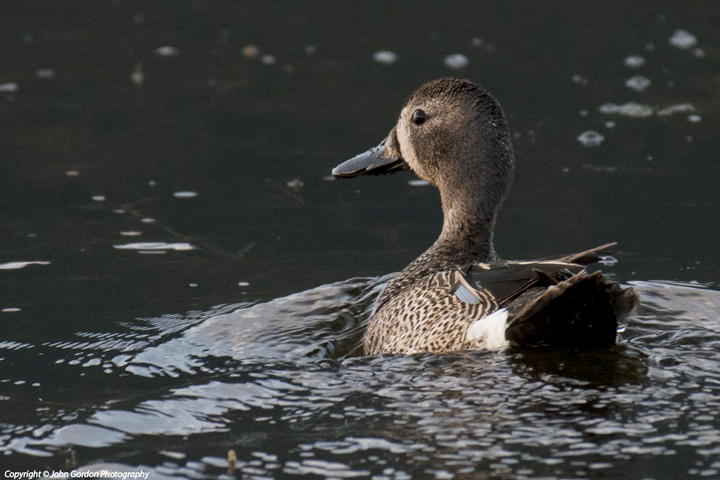
Blue-winged Teal


The afternoon winds subsided leaving Duck Lake a millpond.


A great Blue Heron hunts in the food rich waters of Duck Lake.

Eastern Kingbird
 Duck Lake
 P1000

"It's never too late to post another blog"
John Gordon
Langley/Cloverdale 
BC Canada

BCFO Conference Golden BC

 Moberly Marsh Survey Route.
Golden BC


After some excellent birding on the first day of the June BCFO Golden Conference those birders that had signed up for the Moberly Marsh Sunday morning walk were well prepared with rain gear and gumboots. 
Despite rain and grey skies the morning immediately kicked off with a great find all thanks to the finely tuned ear of Adrian Leather. We hadn't gone more than a few hundred metres when he was quickly onto a pair of Le Conte’s Sparrows. We eventually heard a total of five and that was just along our pathway. How many others were spread out over the many acres of fields would be interesting. 


Le Conte's sparrow


Not much further along from the Le Conte's our group were lucky enough to observe a small colony of Bobolinks.
 Such a treat for the Lower Mainland birders who would normally have to visit the Okanagan for any type of view. The long uncut meadow grasses harboured numerous species of flowers and an incredible amount of insect life.


A female Bobolink perches on long grasses.


The owner of the field who we eventually met at the end of out walk has the insight not to mow his fields until after the nestlings have fledged. I hope a letter of appreciation from BCFO goes to him.

Male Bobolink

As the group walked on I became distracted by a movement on the bushes, it was soon obvious that a pair of Bobolink were courting. Although I missed the birds passing food to each other it does show an interesting interaction nethertheless. 


The Courtship

Female Bobolink

All images D500 and  Nikon 200mm-500mm F5.6


The Nikon D500 and the comparatively lightweight Nikon 200mm-500mm F5.6 is the perfect set-up for a birder on the move. It allows for long distance hikes, composing on the fly and the capture of a wider variety of images than carrying a fixed 500mm or 600mm with gimbal head and tripod. It's also far easier to travel on planes and so far I haven't noticed much if any difference in image quality. Where the more "professional" set-up wins is when the photographer goes after a specific subject matter and there may be much standing around waiting for the quarry.


Already LeConte’s and Bobolinks and we had only been birding thirty minutes. More great sighting were to come including a nest with a Western Wood Pewee and a squabble between a crow and a pair of Bullock’s Orioles which led to some interesting interactions. No one seemed to worse for the fracas.


Nest building

A Western Wood-Pewee weaves a nest.


 Sixty-five species later a soggy but contented group of birders returned to our cars but not before spotting a pair of Sandhill Cranes, a highlight for many in the group.
A big thanks goes out to our guide Verena Shaw for arranging permission to access the private property and the BCFO for making it a memorable convention.


American Redstart

"It's never too late to post a blog"
John Gordon
Langley/Cloverdale 
BC Canada