Now and then I find an interesting story online. Enjoy!
http://m.jsonline.com/news/wisconsin/endangered-wisconsin-kirtlands-warbler-found-in-the-bahamas-b99478504z1-299346411.html
Saturday, 11 April 2015

Friday, 10 April 2015
Nikon P900 Review Test #1
April 2015 Locarno Beach Vancouver, Boundary Bay and Hope Airport
The skimpy starter guide that comes with P900 suggests the camera should be used with a monopod or tripod. Despite that, all these shots were taken handheld using proper holding technique. By proper holding technique I mean holding the camera tightly, tucking the elbows into the rib cage and holding your breath when depressing the shutter. Don't expect sharp images if the camera is held away from the body, just the action of depressing the shutter will cause enough movement to compromise a shot especially when zoomed out beyond 1000mm. One of the features I like most is the electronic viewfinder, is quite usable and makes photographing birds way easier than other bridge cameras I have used. More importantly the VR or vibration control on this camera also works very well.
Below is a rare (for BC) Loggerhead Shrike taken handheld in dullish lighting conditions. I am very happy how it turned out.
For birders who want to document their precious discoveries I believe that with a little practice this camera will fit their needs, especially those who already have a scope to lug around.
For more Loggerhead Shrike pictures see previous blog.
 |
| Loggerhead Shrike |
The P900 is fun to use. I have already used it successfully to document scenics, wildlife and I didn't have to change lens, carry a heavy tripod or worry about neck or shoulder fatigue.
This is not a camera for those shooting stock or for those want to make large prints. However if your purpose is to have a handy tool to identify birds or post on a blog or ©Flickr then I can say this might just be the answer.
The shots below was taken at the camera's 357mm zoom position which when translated to 35mm equivalent equals an amazing 2000mm. When the camera is turned on it opens at 24mm F2.8 but when zoomed out to 2000mm the lens is F6.5, about the same as the Tamron 150mm-600mm. That's way longer than any of the lenses you see many bird photographers carrying around. Granted the chip is way smaller and the light gathering capabilities will fall way short at the beginning and end of the day. However the times when there is decent light the camera works admirably.
All these images except the Pied Grebe were taken with the optical zoom. The grebe shot was taken with the digital zoom which I have turned off for most situations.
 |
| Moon. |
Afterwards I realized the autofocus was set to face detect mode. I have now changed it to single focus area mode so I can decide where the camera focuses.
 |
| Clouds Patterns Boundary Bay. |
 |
| Palm Warbler |
Note: If the subject doesn't move then you will get ten identical shots so it is best used for moving subjects like s bird flying. As you can see the camera doesn't handle highlights that well so a little exposure tinkering may have to be done. This can be quickly done with + and - buttons on the back of the camera. To be fair it was getting toward late morning and the light was getting a little harsh.
The Mountain Bluebird at Locarno Beach was a little different from the Palm Warbler. It was quite approachable and tended to come to predictable perches. This shot is again quite usable for blog or forposting on websites. I think an 8x10 print would be just fine. For a $700 camera that can't be bad.
I had to zoom out to get this ship in the picture. I shot a small plane flying overhead and could see the pilot in the cockpit.
Again handheld, I could have used the macro function but I wanted to include the sky for colour contrast so I used the 24mm wide angle.
The P900 dealt with this backlit scene very easily. I didn't need to add any exposure and shot this from about ten feet away and zoomed into 2000mm to frame the shot.
This low resolution picture here demonstrates not so much the photographic potential of the camera but it as a great tool for identification purposes.
This pied Grebe was so far away binoculars were needed to ID the bird. Beyond the 2000mm optical reach is an extended digital zoom. I am not too sure how long that is but someone out there might let me know.
If you are looking for a camera to take birding I hope this helps you make up your mind. I believe the P900 will with a little practice make your birdwatching an even better experience. Digital photography has changed the way we bird, the P900 is one such advancement.
Note: Apart from being a *Nikon NPS member I have no affiliation with Nikon.
*NPS Nikon Professional Services
 |
| Mountain Bluebird |
 |
| English Bay Ship. |
 |
| Using the lens at 24mm made this image a snap. |
 |
| Shapes and Patterns |
 |
| Pied Grebe photographed with digital zoom mode. |
This pied Grebe was so far away binoculars were needed to ID the bird. Beyond the 2000mm optical reach is an extended digital zoom. I am not too sure how long that is but someone out there might let me know.
If you are looking for a camera to take birding I hope this helps you make up your mind. I believe the P900 will with a little practice make your birdwatching an even better experience. Digital photography has changed the way we bird, the P900 is one such advancement.
Note: Apart from being a *Nikon NPS member I have no affiliation with Nikon.
*NPS Nikon Professional Services
"It's never too late to start birding"
John Gordon
Langley/Cloverdale
BC Canada
Tuesday, 7 April 2015
A Golden Eagle and a Murder of Crows
April 6 2015 72nd Ave Delta BC Canada
This first shot of the Golden Eagle was taken on April 1st during a short photo session before dusk.
 |
| Juvenile Golden Eagle (Aquila chrysaetos) |
As this bird matures the white patches will be replaced by an all dark plumage.

A few days later I took about twenty shots of the same Golden Eagle being harassed by American Crows sometimes referred to as a 'Murder of Crows"
I particularly like the crow's expression on the top left.

Finally outnumbered, the much larger Golden Eagle is driven away from its hunting grounds by a many as fifty crows. I like the symmetry of this image, each crow having a slightly different shape. Many of the crows have white markings and I'm not too sure if they are Northwestern Crows or the American Crow.
The shot came about at dusk, when the Eagle taking it's last hunting foray of the day ran into the crows which were massing for their nightly roost.
No two days seem the same when birding, which I suppose is the what makes the pastime so interesting.
Check out CBC's Nature of Things
April 19 2015 2 p.m
"It's never too late to start birding"
John Gordon
Langley/Cloverdale
Sunday, 5 April 2015
A Rare Bird/Another Twitch
Who doesn't love a good twitch? Ever since a rare Loggerhead Shrike was spotted Wednesday a steady stream of birders have been making their way up the valley to Hope. Hope Airport is famous for producing 'good birds' and this time was no exception. It's also a good excuse to catch up with fellow birders and share some yarns.
I spoke to a few long-time birders, one of whom had been waiting a 'mere' forty years to tick a BC Loggerhead. Another life long birder told me he had been looking fifteen years to add it to his Canada and BC list. It was a big deal to everyone who came, be it with bins, scope or camera.
 |
| Loggerhead Shrike (Lanius ludovicianus) D7100 500mm F4 and 1.4 converter. ISO 800 |
 |
| Finally the sun came out for a few minutes otherwise it was overcast. Nikon D7100 and 500mm F4 with 2x converter. |
 |
| Pic #3 Tamron 150mm-600mm on the D7100. |
 |
Nikon 500mm F4 and 2x Converter |
 |
| Loggerhead Shrike taken handheld at 357mm which equates to 2000mm on the cropped sensor of the Nikon P900. I originally bought the lens to shoot video but as you see it does a great job of stills. |
See next blog for a few more shots with the P900.
"It's never too late to start birding"
John Gordon
Langley /Cloverdale
BC Canada
Friday, 3 April 2015
British Columbia Field Ornithologists/ Nikon P900
April 3/15
I have been a member for a couple of years now and both years I have been or going on road trips during their annual conventions but I promise to attend in 2016.
Meanwhile for those of you who are not aware of all their good works and the amazing birders who make it run all smoothly here is a link.
http://bcfo.ca
The image below was taken with the new Nikon P900 Bridge camera. It has a 24-2000 zoom lens and although not as fast to focus as a DSLR it would be ideal for the casual birder/photographer who wants to ID birds from long distances or even produce shots like this. I will post a longer review later. At $700 I think it is good value, lightweight and great fun to use.
 |
| Palm Warbler( Dendroica palmarum) |
John Gordon
Langley/Cloverdale
BC Canada
"It's never too late to start birding"
A Warbler, A Bluebird and an Owl.
Mar 31/15 Jericho Park Kitsilano Vancouver 12c Sun and Clouds
Back from the Okanagan (see previous blog) I made my way down to find the Palm Warbler, a species not often see in the Lower Mainland. I looked forward to seeing the Kitsilano bird. My only other sighting was a brilliant male palm in Richmond Park East. That same the day, April 22nd 2012 I also photographed a vagrant Ladner Dicksissel. Quite the day!
 |
| Palm Warbler (Dendroica palmarum) and cherry blossom. |
 |
Occasionally the palm would drop an insect and swoop to the ground to pick it up.
 |
| Trying to get a clear shot with sky proved quite a challenge, this shot was one of my favourite. |
A funny thing birding, especially whenever there's a twitch, there no need to look for the bird, just head for a crowd of people staring into a tree. Many I am told are frequent visitors to their chiropractors with the dreaded 'Warbler Neck'
The diminutive Palm Warbler, weighs in at just 7 grams would be much harder to find were it not for all those eyes to help. I am not too sure who first found the palm but a huge thanks for posting your find, allowing the rest of us the opportunity to add the bird to our list. I'm sure a few of the thirty present took time off from work...or school to enjoy watching the bird!
Who would have thought to look in those particular trees in the first place, outside an apartment block when there are acres of parkland right next door! I suppose the profusion of flowers and the protein rich pollen was the attraction for the bird. Also in the tree were a number of Pine Siskin.
************
After the palm I made my way down to nearby Locarno Beach to catch up with a very accommodating Mountain Bluebird. I had never seen them in the Lower Mainland. After photographing the bird I think I discovered why it seemed to like this particular spot. Watching the bird feed on an plentiful supply of insects I sat back and watched it come to a nearby log, it paused looked at the other photographers and then began to drink out of a small crack where rainwater had gathered following recent rains.
 |
| Mountain Bluebird (Sialia currucoides) |
Note the water drop reflecting off the bird's breast.

Occasional the bird would take flight to hawk insects and land on one of two bushes on the beach.
 |
| Locarno Beach taken with Nikon P900 |

Later in the day I visited Queen Elizabeth Park, where Tulips and Daffodils and Cherry were in full bloom. It was 20c and there wasn't much bird captivity. Bushtits making nests, Spotted Towhees, Pine Siskins, Rufous and Anna's Hummingbird were ALL I saw, very quiet indeed. I was looking for Hutton's Vireo so if anyone can help me in that endeavour, that would be greatly appreciated. There were however plenty of people enjoying the sunshine, peace and quiet. I had a picnic and watched the tourists photographing the flowers and then dozed off for a few moments.
Later in the day I spent an hour at Harbour Park before heading for sumptuous supper at the local Golden Arches. It had been a long day but more birding was ahead.
**********
Boundary Bay at dusk 7.30 p.m
 |
| Barn Owl (Tyto alba) |
 |
| The Hunter: Shot after sunset light from the sky illuminates the wings. |
Another day's birding came to an end as darkness fell. With the Barn Owl my BC year list now stands at 120 species. It's my first attempt at a year list so I gives me impetus to search out new species and get know other parts of the province and when the snow melts, the rest of Canada.
It had been a long day and on the drive home the warmth from the car's heater nearly sent me to sleep and into a ditch. I must have been dreaming of that baked potato topped with melted butter and cheese and the game of footy waiting for me on the PVR.
At home memories of day flooded back into my mind, especially the moment earlier in the day when another birder mentioning to me how she cherished every moment of life especially when she birded, she then rambled off some Latin phrases, the only part I understood was the the bit about Carpe Diem, and on that I completely agree.
"It's never too late to start birding"
John Gordon
Langley /Cloverdale
Management takes no responsibility wordiness and grammatical errors, the author was probably asleep in English class although to his credit did get an 'O' level in English literature.
Monday, 30 March 2015
From Kamloops to Osoyoos
March 27-28 2015 Kamloops to Osoyoos, The Okanagan Valley BC Sun and Clouds 16c in the Valley 3c in the Mountains.
With high expectations five of us Roy, Daniele and Brian, myself and our fearless leader Mel left cloudy Vancouver and headed to bird various locations between Kamloops to Osoyoos.
There are plenty of great birding spots around the Kamloops area, many of which can be found in Russell and Dick Canning's book Birdfinding.
One particular bird I didn't expect to see was a Burrowing Owl.
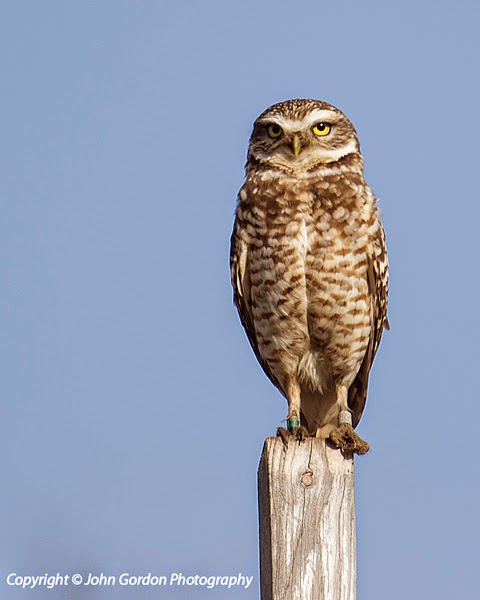 Burrowing Owl (Athene cunicularia) Note the tags. |
These particular Burrowing Owls are re-introduced birds and much hard work has gone into giving them a chance to re-establish in the grasslands. The owls migrate south in the winter and return in the spring. The birds are free to go as they please so the re-introduction can so far be considered successful. Hopefully the birds will now breed and their numbers will increase with time.
|
 |
| The Burrowing Owl nests underground usually in disused badger dens of which I don't think there are any. Instead man made burrows have been built to offer shelter and nesting. |
The sounds of the Meadowlarks call carrying across the grasslands was breathtaking. Fleeting views of a Northern Shrike and Vesper Sparrows were just a taste of what is to come. Soon Horned Larks and Clay-coloured Sparrows will arrive en masse.
 |
| Western Meadowlark ( |
We made our way back toward Kamloops and on to the Tranquille area. At Rattlesnake Bluffs we searched for Canyon Wrens but no luck, we were however visited by an accommodating Say's Phoebe.
Rattlesnake Bluffs
Nature Conservancy of Canada Property
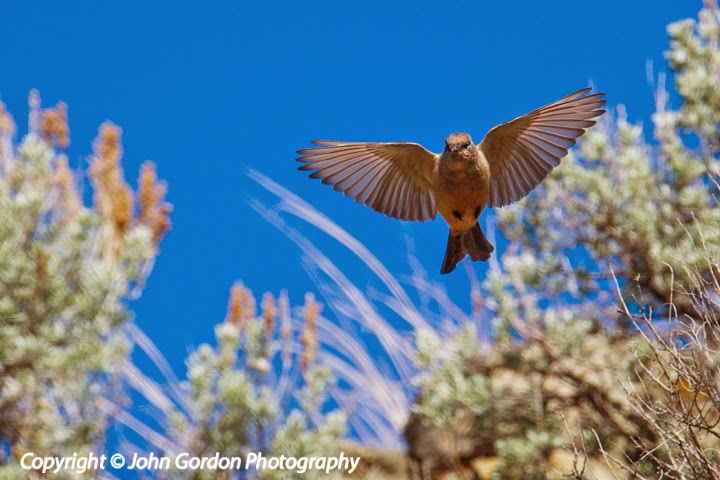 |
| Say's Phoebe (Sayornis saya) |
Sunlight reflected off the canyon walls lights up the wings of dainty flycatcher. This is a good place for Chukar, Canyon Wren and nesting White-throated Swallows.
Say's Phoebe feed on insects and can be very vocal and are easily approached compared with some species.
 |
| Bighorn Sheep at Vaseux Lake. |
 |
| Chukar (Alectoris chukar) Tamron 150mm-600mm |
*****************
Leaving for Kelowna we looked for less travelled areas where we spotted both Western or Mountain Bluebirds hawking insects. Many were already populating nest boxes. Soon the Lazuli Bunting will be arriving adding to the colourful display.
 |
| Pygmy Nuthatch (Sitta pygmaea) Tamron 150mm-60mm handheld |
In the trees Pygmy Nuthatches were excavating nest holes and squabbles between Northern Flickers and European Starlings provided an entertaining distraction from looking for owls. On a previous trip I found one particular tree with all the above three species nesting within feet of each other.
Moving on we had a tip from a local birder that a Western Screech Owl had been seen so we searched and found a spot with enough "whitewash" to indicate an owl had indeed used the tree to roost. We returned at ten o'clock that night and after an hour and applying a few calls a Western Screech Owl flew into a closeby branch. Having never photographed owls at night I had no idea to expose for the shot so my images are dismal...... to their credit Brian and Roy got some nice images. We got back to our hotel at 2 a.m completely knackered.
******
******
Next day working on another tip we tried another spot but again no owl. We moved on deciding to return later in the day.
We left the balmy weather of the Okanagan Valley with blue skies and cherry blossom for the high mountain logging roads where it was cold and grey. Our search for woodpeckers was fruitless, we could hear them but had to settle for flocks of Mountain Chickadees, a bird I haven't seen too much of and was quite happy to photograph. I would have liked to have stayed longer but birders don't hang around like photographers. I must be a hybrid because I can do both but not at the same time!
 |
| Mountain Chickadee (Poecile gamble) |
 |
| Western Screech Owl (Otus kennicottii) |
Finally an owl in daylight, something I could manage and after blowing the shot the night before I felt a lot better, finally I have a decent image of species that I had only seen once before.
Eventually the two day photo expedition came to an end. A huge thanks from all of us should go out to our fearless leader Mel who went way beyond the call of duty to make sure we had an interesting
itinerary. We covered 1300 kms from Vancouver to Kamloops and Osoyoos and back but without the effort we wouldn't have had such an amazing experience.
As an aside I will be trying out the new Nikon P900 24mm-2000mm bridge camera in the next few weeks. It might make a great birding lens for those who don't want to lug around too much gear and just want to post on Flickr and not be bothered with exhibition quality images. It even has a birding mode where it takes a high sequence of frames.
As an aside I will be trying out the new Nikon P900 24mm-2000mm bridge camera in the next few weeks. It might make a great birding lens for those who don't want to lug around too much gear and just want to post on Flickr and not be bothered with exhibition quality images. It even has a birding mode where it takes a high sequence of frames.
"It's never too late to start birding"
John Gordon
Langley/Cloverdale
Management takes no responsibility for grammatical errors.
Management takes no responsibility for grammatical errors.
Subscribe to:
Posts (Atom)