Showing posts with label Western meadowlark. Show all posts

Monday, 30 March 2015

From Kamloops to Osoyoos


March 27-28 2015 Kamloops to Osoyoos, The Okanagan Valley BC
Sun and Clouds 16c in the Valley 3c in the Mountains.


With high expectations five of us Roy, Daniele and Brian, myself and our fearless leader Mel left cloudy Vancouver and headed to bird various locations between Kamloops to Osoyoos. 
There are plenty of great birding spots around the Kamloops area, many of which can be found in Russell and Dick Canning's book Birdfinding.
One particular bird I didn't expect to see was a Burrowing Owl. 
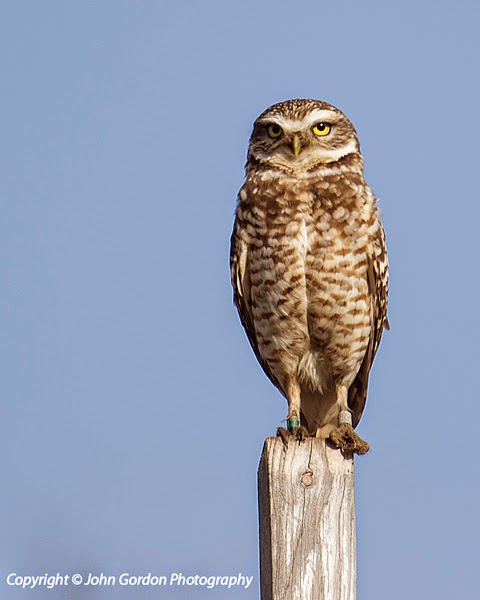


Burrowing Owl (Athene cunicularia)
Note the tags.


These particular Burrowing Owls are re-introduced birds and much hard work has gone into giving them a chance to re-establish in the grasslands. The owls migrate south in the winter and return in the spring. The birds are free to go as they please so the re-introduction can so far be considered successful. Hopefully the birds will now breed and their numbers will increase with time. 


The Burrowing Owl nests underground usually in disused badger dens of which I don't think there are any. Instead man made burrows have been built to offer shelter and nesting.


The sounds of the Meadowlarks call carrying across the grasslands was breathtaking. Fleeting views of a Northern Shrike and Vesper Sparrows were just a taste of what is to come. Soon Horned Larks and Clay-coloured Sparrows will arrive en masse.
Western Meadowlark (
We made our way back toward Kamloops and on to the Tranquille area. At Rattlesnake Bluffs we searched for Canyon Wrens but no luck, we were however visited by an accommodating Say's Phoebe.


Rattlesnake Bluffs
Nature Conservancy of Canada Property
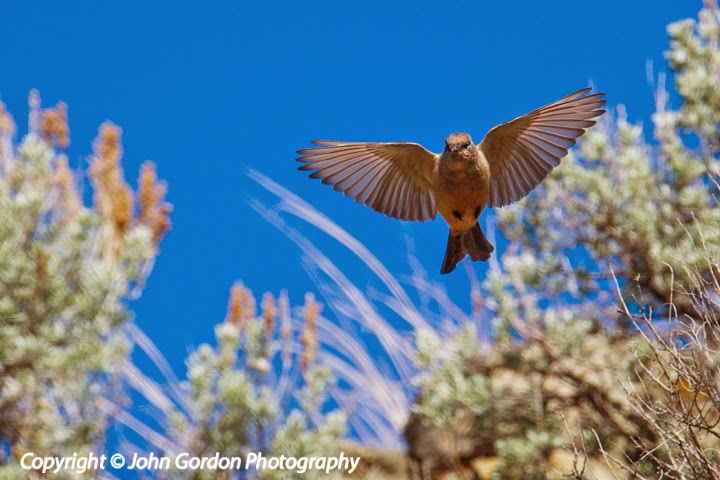
Say's Phoebe (Sayornis saya)


Sunlight reflected off the canyon walls lights up the wings of dainty flycatcher. This is a good place for Chukar, Canyon Wren and nesting White-throated Swallows.
Say's Phoebe feed on insects and can be very vocal and are easily approached compared with some species.


Bighorn Sheep at Vaseux Lake.


Chukar  (Alectoris chukar)
Tamron 150mm-600mm
Across and just before Rattlesnake Bluffs is a railway track where trains pass on a regular basis. Chukar feed grain spilt on the railway tracks, only flying away when a train is almost on top of them. Introduced from the Middle East feral populations are found in the Kamloops area, the Okanagan and in the Princeton area.

*****************
           
Leaving for Kelowna we looked for less travelled areas where we spotted both Western or Mountain Bluebirds hawking insects. Many were already populating nest boxes. Soon the Lazuli Bunting will  be arriving adding to the colourful display.

Pygmy Nuthatch (Sitta pygmaea)
Tamron 150mm-60mm handheld

In the trees Pygmy Nuthatches were excavating nest holes and squabbles between Northern Flickers and European Starlings provided an entertaining distraction from looking for owls. On a previous trip I found one particular tree with all the above three species nesting within feet of each other.

Moving on we had a tip from a local birder that a Western Screech Owl had been seen so we searched  and found a spot with enough "whitewash" to indicate an owl had indeed used the tree to roost. We returned at ten o'clock that night and after an hour and applying a few calls a Western Screech Owl flew into a closeby branch. Having never photographed owls at night I had no idea to expose for the shot so my images are dismal...... to their credit Brian and Roy got some nice images. We got back to our hotel at 2 a.m completely knackered.

                                                                                  ******

Next day working on another tip we tried another spot but again no owl. We moved on deciding to return later in the day.
We left the balmy weather of the Okanagan Valley with blue skies and cherry blossom for the high mountain logging roads where it was cold and grey. Our search for woodpeckers was fruitless, we could hear them but had to settle for flocks of Mountain Chickadees, a bird I haven't seen too much of and was quite happy to photograph. I would have liked to have stayed longer but birders don't hang around like photographers. I must be a hybrid because I can do both but not at the same time!
Mountain Chickadee (Poecile gamble)
This picture was taken up at the snow line where snow lined the logging road and the temperature was a chilly 3c.


Western Screech Owl (Otus kennicottii)
Finally an owl in daylight, something I could manage and after blowing the shot the night before I felt a lot better,  finally I have a decent image of species that I had only seen once before.

Eventually the two day photo expedition came to an end. A huge thanks from all of us should go out to our fearless leader Mel who went way beyond the call of duty to make sure we had an interesting 
itinerary. We covered 1300 kms from Vancouver to Kamloops and Osoyoos and back but without the effort we wouldn't have had such an amazing experience.

As an aside I will be trying out the new Nikon P900 24mm-2000mm bridge camera in the next few weeks. It might make a great birding lens for those who don't want to lug around too much gear and just want to post on Flickr and not be bothered with exhibition quality images. It even has a birding mode where it takes a high sequence of frames.


"It's never too late to start birding"

John Gordon
Langley/Cloverdale


Management takes no responsibility for grammatical errors.


Thursday, 2 January 2014

Langley Christmas Bird Count 2013


Dec 29 2013  Langley Christmas Bird Count

         Langley Field Naturalists
                                                        
Sheila Puls and Kathy Masse
Langley Field Naturalists 
 Photos John Gordon

On Sunday, December 29 dedicated Langley Field Naturalists divided into 5 teams and set out from their meeting spot at ABC Country Restaurant with their clipboards and binoculars, to spend the day counting every bird they saw, both numbers and species, in the assigned count area.  It was the annual North America Christmas Bird Count and the Fields Naturalists covered a pie shaped area, which is part of the large circle of the White Rock/Surrey Count area.
The day was drizzly and cool but happily the rain stopped after an hour.  At 4:00 pm, we met again, to warm up with a hot chocolate and to tally final numbers.  Stories of rare bird sightings and adventures of the day were shared and enjoyed by all.
We saw 67 different species which is one more than seen last year.  However our overall numbers were only six thousand and sixty-one, down from eight thousand last year, probably because of the misty weather.  We found American Robin counts are up. A highlight was the Cinnamon Teal which is rare in Langley in the Christmas Bird Count.  Some saw large flocks of Pine Siskin, and American Goldfinch.  A  Peregrine Falcon and 3 American Kestrels rounded out other unusual sightings.  
The 2013 Christmas Bird count, as it is each year, was a satisfying successful day for the Langley Field Naturalists!

Below are the stats from our group Mike Klotz and myself.
Pileated Woodpecker (Dryocopus pileatus)
At 16.5 inches tall and a 29 inch wingspan, the Pileated woodpecker is the largest of North American Woodpeckers.

Due to overcast and foggy conditions Sunday wasn't the best of days for a bird count but as the five groups from the Langley Field Naturalists (LFN) spread across Langley hopes were high. I birded with Mike Klotz.  Below is the e-bird list Mike logged on his iPhone. One of the first birds we saw was a Belted Kingfisher followed a few minutes later by a Pileated Woodpecker. Both birds were seen on the Nikomekl Rotary Park floodplain in Langley City. Here are our groups stats (1 of 5 groups)


BirdLog Checklist Summary for: Sunday, Dec 29 2013


Number of Checklists: 5
Number of Species: 42

Checklists included in this summary:
(1): Nicomekl Park
Date: 2013-12-29 8:08 AM
(2): Langley--Fraser Hwy & Serpentine River
Date: 2013-12-29 10:13 AM
(3): CA-BC-Langley- Sendall Gardens
Date: 2013-12-29 11:14 AM
(4): Langley--Fraser Hwy & Serpentine River
Date: 2013-12-29 12:55 PM
(5): Langley-Blacklock School
Date: 2013-12-29 2:15 PM

18 Greater White-fronted Goose -- (4)
30 Canada Goose -- (1)
2 Gadwall -- (1)
188 Mallard -- (1),(2)
2 Ring-necked Duck -- (2)
2 Greater/Lesser Scaup -- (2)
2 Bufflehead -- (2)
15 Hooded Merganser -- (2)
8 Common Merganser -- (2)
1 Double-crested Cormorant -- (2)
4 Great Blue Heron -- (1),(2)
1 Northern Harrier -- (1)
1 Bald Eagle -- (2)
1 Red-tailed Hawk -- (2)
3 Ring-billed Gull -- (5)
5 Glaucous-winged Gull -- (4),(5)
8 Rock Pigeon (Domestic type) -- (4)
1 Anna's Hummingbird -- (3)
1 Belted Kingfisher -- (1)
2 Downy Woodpecker -- (1),(2)
1 Northern Flicker -- (1)
1 Pileated Woodpecker -- (1)
4 Steller's Jay -- (1),(3)
46 Northwestern Crow -- (1),(2),(3),(4),(5)
1 Common Raven -- (3)
34 Black-capped Chickadee -- (1),(2),(3),(4),(5)
1 Chestnut-backed Chickadee -- (1)
4 Pacific Wren -- (1),(3),(5)
2 Bewick's Wren -- (1),(3)
9 Golden-crowned Kinglet -- (1),(3)
7 Ruby-crowned Kinglet -- (3)
26 American Robin -- (1),(2)
2 Varied Thrush -- (1)
104 European Starling -- (2),(4)
4 Spotted Towhee -- (1),(4)
3 Fox Sparrow -- (1),(2)


Song Sparrow (Melospiza melodia)
One of the common birds observed.

14 Song Sparrow -- (1),(2),(4)
2 Golden-crowned Sparrow -- (1),(2)
15 Dark-eyed Junco (Oregon) -- (1),(2),(3)
3 Western Meadowlark -- (4)
4 House Finch -- (1)
16 House Sparrow -- (1)
Western Meadowlark (Sturnella neglecta)
The highlight of the day were three Meadowlark near the Langley Airport.


Friday, 26 October 2012

A Mixed Bag

Oct 25th 2012 Mixed cloud and sun.
 Iona Regional Park Richmond B.C.
With family commitments put away and the weather forecast predicting a dry and sunny day I set off for Iona Regional Park in Richmond. Driving up to the parking lot five Western meadowlarks could be seen eagerly searching for food. These prairie birds seem to feel quite at home on the sand that has been deposited here over the millennium. Meadowlarks are most noticeable when they perch in the few bushes which have sprouted up along the beach, however they do spend most of their time scurrying around in the long grass, ever wary of the northern harrier and other raptors looking for a meal.
As per usual I met number of really interesting birders and photographers, exchanging niceties about lens length etc (a male obsession), bird lore and the latest sightings.. it beats working!
 My favourite shot of the day was the Goldfinch (below) which was taken half-way through once such discussion, it pays to keep attentive!

American goldfinch  

Northern Harrier hunting.
Keeping an eye out for trouble!


Great horned owl (note the white around the throat)


Anyway, after photographing a flock of American goldfinches that were feeding on seed heads the subject of a Great horned owl came up in  conversation. This news sent me scurrying off to the Terra Nova garden allotments in Richmond. A small murder of crows immediately gave away the owls location. The bird has become quite the celebrity, it barely moved as a procession of schools groups and seniors filed to get a good look. It was perched about fifteen feet from the ground where it nonchalantly  viewed all and sundry.
The bird has become quite the hunter dispatching two barn owls over the last few  days. Apparently the Great horned owl doesn't like competition, it has even attacked a gardener!