Showing posts with label sumas Prairie. Show all posts

Thursday, 4 December 2014

Cold Snap Birding and other Musings

Dec1-2 2014 Reifel/Sumas Prairie/Boundary Bay Sunny -5c.

The Lower Mainland and Vancouver area is/was in the midst of a cold snap with night time temperatures plummeting to minus 5c. It isn't Saskatchewan yet but it's still really cold for us on the coast. During the day the warmth of the sun and cobalt blue skies made it perfect for a birding. It sure beats the grey skies and rain!

                                                                             ****

Sometimes we see another photographers personal take on the natural world and wonder why on earth we didn't see that ourselves.
That was the case last year when I saw a fantastic image of an American Coot photographed by Jim Martin. Among other photographic projects, Jim supplies most of the excellent images for the Reifel Migratory Bird Sanctuaries quarterly magazine Marsh Notes. I think the coot was on the front page but the image really spoke to me and got me thinking. The picture encouraged me to search out my own version for which I needed a frozen pond and a good stretch of cold weather.
Jim had photographed an American Coot during a similar cold snap. For his shot the Reifel ponds were frozen and there was his amazing shot showing the Coots strange looking webbed feet as it stood on the icy pond. This is something we don't often see as the coot spends most of its time in the water and the feet are often hidden.
Here is my humble take on the subject. Now thanks to Jim I am going to take more attention to what is happening in front of the lens!


American Coot (Fulica americana)
                                                                               ****

Next up was a trip to windy and bitter cold Sumas Prairie. The goal was to search out some of the numerous raptors which make their home in and around the farmer's fields each winter. The birds are spread out over kilometres of roads and farmland. They can be hard to find. Distances travelled can be high so car pooling lessens the carbon footprint, if only a little. Car pooling is something I encourage others to try as much as possible.
The first bird on the agenda was the Gyrfalcon. What a splendid name for a bird of prey, sounds like something out of a Harry Potter book. Anyway, not only did I see the Gyrfalcon hunting I and others watched in awe as a Peregrine Falcon and a Bald Eagle chased the gyrfalcon, eventually forcing it to drop its catch. Such is life on Sumas Prairie. Below is my humble effort to show two of the fastest birds on the planet in an acrobatic aerial display.
Gyrfalcon (Falco rusticolus) and Peregrine Falcon (Falco peregrinus) clash.
The blue bar on the right of the picture is an irrigation pipe.

Avery distant ID shot of a first year Dark Morph Red-tailed Hawk (Buteo jamaicensis)
Next up was a dark morph Red-tailed Hawk. This picture is taken from quite a distance but shows just enough of the colouring to correctly identify it. Red-tailed Hawks have an incredible amount of variations. Last year I photographed a Harlan's Red-tailed Hawk, a rare sub species on Sumas Prairie.


Below is a flock of two hundred Trumpeter Swans. Hard to imagine that this would have represented the entire worlds population less than fifty years ago. Hunting and lead poising decimated the population. This flock had found a field with plenty of potatoes and were busily chomping way, oblivious of the passing farm machinery.


Trumpter Swan (Cygnus buccinator)
One of the Trumpeter Swans with tag 200K. Anyone where to send this info?

After the Sumas Prairie I decided to take a break from the cold winds and try out Boundary Bay. Having photographed Great-horned and  Barn Owls last week I was lucky enough to stumble on a Long-eared Owl that had drawn the attention of a group of photographers. When I arrived the sun was still strong but a blackberry bush was casting a strong shadow across the bird making it a less than ideal shot. I decided to wait and come back when the light was waning thus softening the shadows. Below is the image just as the sun set. Shot at 3200 ISO on a tripod with the Tamron 150mm-600mm. Why 3200 ISO, a speed I normally never use? I wanted to try out the auto ISO function and that is what I got. I have the images, it looks fine plus I'm not ever going to print it so i'm happy.
Long-eared Owl (Asio otus)

The last three images were taken with the Tamron 150mm-600mm. I did a quick test shooting the same bird at 500mm and 600mm. I couldn't see any discernible difference.
The coot and Sumas Prairie shots are taken with a 500 F4 and D300s or D7100.
Short-eared Owl (Asio flammeus)


While waiting for the Long-eared I walked a few hundreds metres along the dyke. I waited until the Northern Harriers and Short-eared Owls began hunting. The owls usually come out around 3p.m. the harriers hunt all day. Again this is a huge crop of the Short-eared Owl and works well as an ID shot. 
For those thinking about moving up from just scoping to actually photographing birds. The Tamron or the Sigma 150mm-500mm or the Nikon 80mm-400mm are all good low cost options to try out  before deciding to go for one of the "Big Guns" and the associated cost and weight.


Moonrise and Yarrow/ Boundary Bay
It had been an amazing few days of birding, a week of blue skies, the birds and the weather, a real treat those of us on the Pacific Northwest.


                                                    It's never too late to start  birding"

                                                                      John Gordon 
                                                               Langley/Cloverdale

Saturday, 15 November 2014

Fraser Valley Birding


Nov 11/14 Sumas Prairie Abbotsford BC Cold 1c

American Pipit (Anthus rubescens)

Driving around Sumas Prairie in sub zero temperatures looking for raptors can be a frustrating experience. On calmer days American Kestrels, Red-tailed Hawks and even the odd Golden Eagle can make it an exciting place to bird. We did find a dark phase intermediate Red-tailed Hawk but the buffeting winds made holding the camera still somewhat of a challenge. The American Pipit (above was shot from the car window from about twenty-five metres with the Tamron 150mm-600mm. I bought the lens for situations like this when a larger lens would have been too cumbersome to set up in the cramped quarters of a small car. With no Black-backed Gull to be found we headed toward Mission to find Bald Eagles that had congregated to feed on spawned out salmon.

Varied Thrush (Ixoreus naevius)
Another car window shot with the Tamron. The lens is so light and agile it can be very useful in situations where a wary bird like the Varied Thrush can only be approached by using the car as a blind. Plus it was really windy and cold outside.


Bald Eagle (Haliaeetus leucocephalus)
An adult Bald Eagle (left) clashes with a 2nd year bird on Nicomen Slough. The spent salmon the eagles were fighting over can be seen in the water below the birds.


"It's never too late to start birding"
John Gordon
Langley Cloverdale

Saturday, 22 February 2014

Langley Field Naturalists Outing Feb 21/14

                                                                                                  Anne Gosse Photo
Looking for the the elusive Golden Eagle.

Feb 21/14 Sumas Prairie Sunny and Cold.

Although much of my birding is done alone the opportunity to go out as a group offers some great benefits. The obvious being more eyes scanning fields, trees and fences and of course, the camaraderie. Secondly there're always a few experienced birders who can help the rest of us who are still on that steep learning curve. As was the case Friday, when a group of Langley Field Naturalists and others drove through Sumas Prairie in search of the elusive Golden Eagle. Alas we could not locate the bird but did find a rare Harlen's Red-tailed Hawk. For many in the group it was their first ever sighting of this magnificent raptor. 


Anne Gosse who organized the trip is on the far left.


                                      Anne Gosse Photo
John shows Monica Pearson the difference between the
 Harlan's Red-tailed Hawk(sub species) and the more common Red-tailed Hawk.

American Kestrel (Falco sparverius)
We saw at least six American Kestrel hunting, this one at the Great Blue Heronry in Chilliwack.


Good Birding 
 John Gordon            


 Next Field Trips Langley Field Naturalists. contact information below

Saturday, March 8
Meet time: 8:15am at Douglas Park or 9:30 at Maplewood Park
Start time: 10am
What is for Dinner? Raptors of the Conservation Area at Maplewood Flats, North Vancouver
Leader:  Al Grass
Join us as we search out why are flats critical habitats for wildlife. The walk will focus on the importance of raptors such as eagles, hawks, and owls. Meet 8:15 am Douglas Cres. Langley or 9:30 at Maplewood Park. Phone 604-538-8774 for information.


Saturday, March 22, 2013
Time: 9:00 to 12:00
Aldergrove Regional Park
Leader: Bob Puls

Come join the Langley Field Naturalist to awaken your curiosity and engage your senses while exploring nature and the changing seasons in this beautiful regional park! We will check out the winter bird & water fowl activity around the ponds and look at some of this parks features.  Meeting at Aldergrove Regional Park central parking.  Phone 888-1787 or Bob 856-7534 to let us know if you are coming or to carpool from Douglas Crescent.

Sunday, 16 February 2014

Langley Field Naturalists Field Trips

Hi everyone,
As you can see I have been asked to lead the Golden Eagle Quest tour, details are provided below. Sumas Prairie can be very windy and cold so bundle up and hope we are fortunate enough to see one of these magnificent raptors. Depending on the weather we could see American Kestrel, Red-tailed Hawk (various phases) possibly a Gyrfalcon and Rough-legged Hawk. There have also been sightings of flocks of Meadowlark and Snow Buntings.
Everyone welcome especially experienced birders, the more eyes the better! Details below.
Golden Eagle (Aquila chrysaetos) Sumas Prairie 2012


Friday, February 21, 2014
Meet time: 8:00am Douglas Park
Start time: 9:30am
Golden Eagle Quest! Chilliwack Area & Heronry
Leader:  John Gordon
Come join John as he takes us on an exciting search to find one of the largest and most majestic birds of prey that reside in our Fraser Valley - the Golden Eagle!  We plan to look amongst the pretty pastoral farming district of Chilliwack for this large, dark brown raptor. We also plan to drop into the Chilliwack Heronry for a Ring-necked Duck search and to eat lunch. Meet at Douglas Park Rec. Centre at 8:00 for carpooling or at Old Yale Road ESSO - 34515 Old Yale Rd, Abbotsfordjust off  exit no. 109 Yale Rd West, to the right. Phone 604-533-7171 or  604-888-1787 for information.


Saturday, March 8
Meet time: 8:15am at Douglas Park or 9:30 at Maplewood Park
Start time: 10am
What is for Dinner? Raptors of the Conservation Area at Maplewood Flats, North Vancouver
Leader:  Al Grass
Join us as we search out why are flats critical habitats for wildlife. The walk will focus on the importance of raptors such as eagles, hawks, and owls. Meet 8:15 am Douglas Cres. Langley or 9:30 at Maplewood Park. Phone 604-538-8774 for information.


Saturday, March 22, 2013
Time: 9:00 to 12:00
Aldergrove Regional Park
Leader: Bob Puls
Come join the Langley Field Naturalist to awaken your curiosity and engage your senses while exploring nature and the changing seasons in this beautiful regional park! We will check out the winter bird & water fowl activity around the ponds and look at some of this parks features.  Meeting at Aldergrove Regional Park central parking.  Phone 888-1787 or Bob 856-7534 to let us know if you are coming or to carpool from Douglas Crescent.


Tuesday, 28 January 2014

Being in the Right Place at the Right Time

Jan 27 2014 Sumas Prairie
With the wonderful weather coming to a close my birding buddy Raymond and myself took off to nearby Sumas Prairie to find the Gyrfalcon and whatever other birds presented themselves.
Taking Whatcom Road east at Vye it wasn't long before we came across an American Kestrel hunting among the blueberry fields. Within ten minutes the tiny raptor had caught a quite large rodent that looked like a small rat, it was far too big for a mouse or vole.
As luck would have it, the bird at first flew away with its prize only to make an abrupt turn and fly toward us and land on a pole about 30 metres away. It was an exiting moment and more than we expected and we had been birding all of ten minutes.
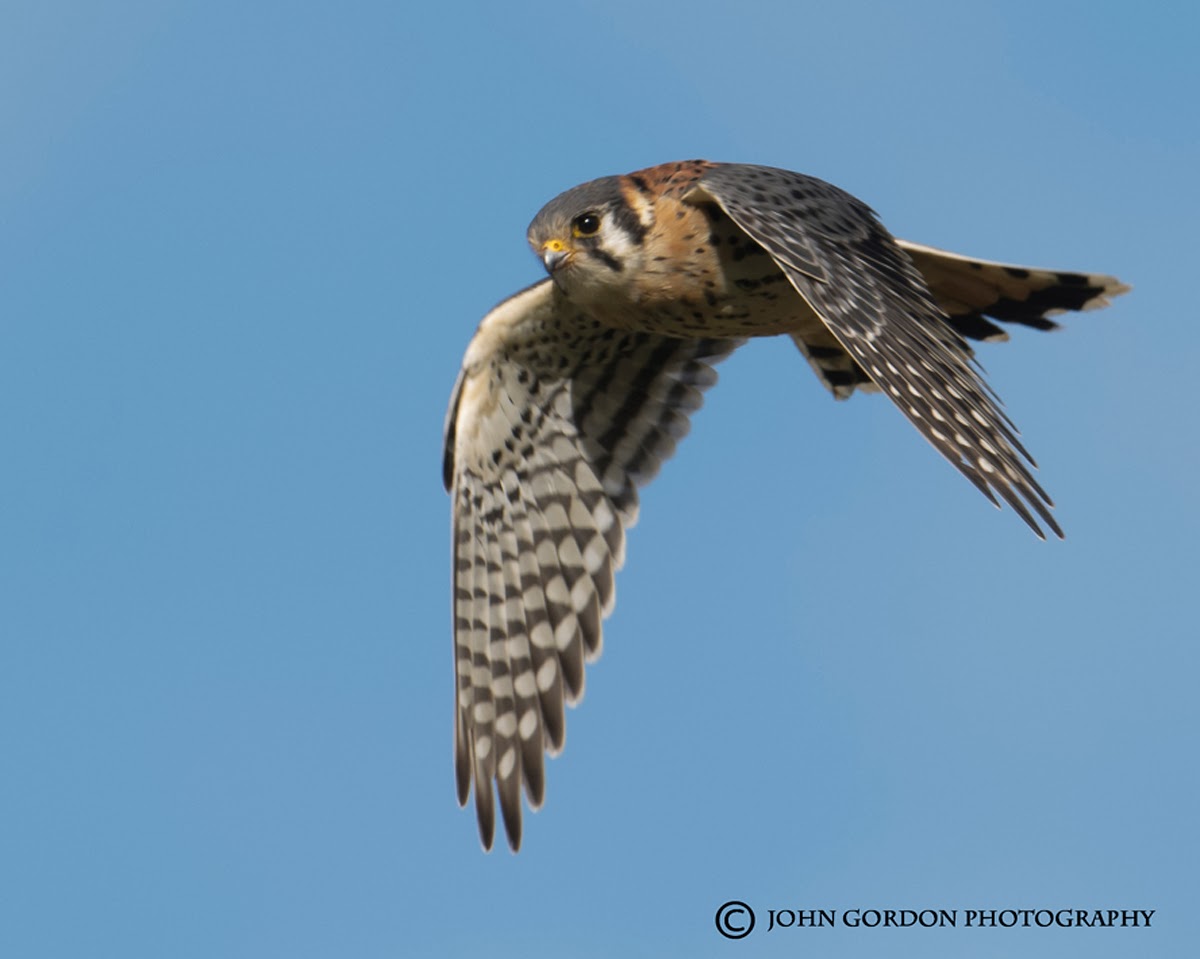
Here is one of the resulting shots.
Female American Kestrel (Falco sparverius)
         Later in the morning we came across this male waiting to pounce on some hapless rodent
American Kestrel. We saw five females and only this one male. 
Below is my first ever photograph of the Harlen's Red-tailed Hawk. Note lack of red tail associated with the normal population.

Harlen's Red-tailed Hawk (Buteo jamaicensis)

A Harlan's glides over the fallow fields of Sumas Prairie.


Yet another great day of birding, full of surprises and new experiences. The Harlan's was a bird I had never seen before so with a change of weather I can now spend the next few days catching up with all or some of the minutiae that gets in the way of my birding adventures.

Good Birding
   John

Sumas Prairie Raptors

Jan 24/14 Sunny Sumas Prairie, Abbotsford B.C.

Sumas Prairie, Abbotsford B.C Jan 24 2014


With Boundary Bay fogged in due to a week-long inversion I decided to head out to sunny Sumas Prairie in search of an elusive Gyrfalcon and some much needed sun. It wasn't long before the Gyr was found but it was too far away to get even a half decent picture. I was happy with the sighting and moved on to search for a Golden Eagle that had recently been seen in the vicinity. 
Following an hour of driving around, scanning every large tree for signs of the Golden Eagle a large silhouette in a distant tree promised success. Even with binoculars the bird was too far way, it was either an immature Bald Eagle or the Golden but I couldn't be certain.
Frustrated by the situation (the bird was on private land) patience again would have to come into play. Hopefully the bird would take flight and in my direction.
A great deal of birding I am finding is part research and the other half, plain good luck. A cold wind buffeted the car while I ate lunch and waited. The waiting reminded me when I used to fish for carp and tench back in the UK. Sometimes waiting hours or even all night for a bite. To bird you need patience, there's no way around it. I once spent ten days in silence at Buddhist retreat so waiting for an hour of two for a bird to move is not really a big deal.
I remember one particular day when after meditating for six or seven days with only minimal sleep my mind was in a quite a tranquil place. The internal chatter of the mind had died down and everything seemed well with the world..so I thought. Just as I was thinking I was getting the hang of the "meditation thing" a flock of birds landed just outside the monastery window. The flock burst into a noisy chatter and all the calm I had acquired suddenly vanished. Bloody birds, I thought. That night, we could if needed ask the monks a question and so I asked her was about the noisy birds and how they disrupted my 'precious' meditation.
Her answer was simple and became the title of my blog "Listen to the Birds". With those few words I understood the concept of letting nature be itself and not to try and impose any thoughts upon it. Those wise words are with me today as I bird and photograph our avian friends.
Suddenly out of nowhere a Bald Eagle flew toward the tree. It became clear the bird in the tree was indeed a Golden Eagle and a fierce battle for territory was suddenly being fought overhead. The Golden Eagle soared in an ever increasing spirals suddenly swooped down to drive the intruder away. No contact was made but there was no doubt who now ruled of the roost.
Who needs the National Geographic channel when we have this in our own backyard!
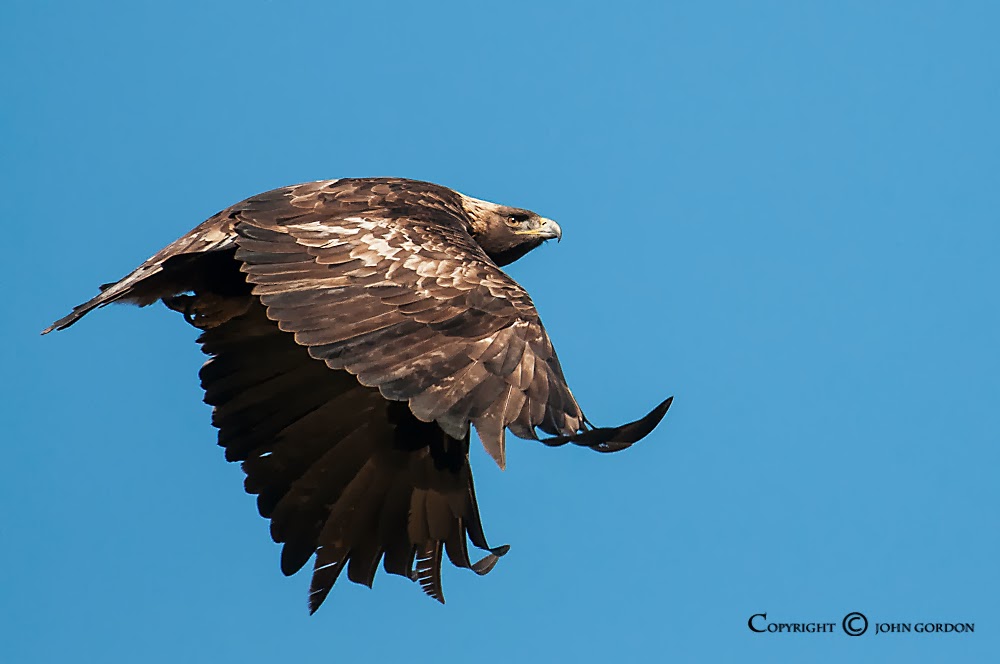
Here is one the resulting shots.


Golden Eagle ( Aquila chrysaetos)


The day continued with sighting of one Rough-legged and seven Red-tailed Hawks, five American Kestrels and one Gyrfalcon and a large flock of Western Meadowlarks.

Rough-legged Hawk (Buteo lagopus)

A long distance ID shot with some nice backlight. 


The day ended with a quick coffee run to the Great-blue Heron Reserve where we were alerted to the possibility of a Lincoln Sparrow hanging out with the Song and Fox Sparrows. An hour later, the shy and diminutive sparrow posed for pictures.
Lincoln Sparrow (Melospiza lincolnii)
Good Birding
John

Monday, 27 January 2014

The Falcon and the Goldfinch


Jan 23-24 2014 /Harbour Park and River Road, Ladner B.C.


Thurs Jan 23/14 Foggy with Sunny breaks

This week I had the opportunity to drop all my household chores and search out some of the raptors species that make the Lower Mainland their winter home.
As an aside, I missed having a five falcon day (no Merlin) that a few birders have had this week but four out of five ain't bad. The four falcons were the Peregrine Falcon, Gyrfalcon, American Kestrel and the Prairie Falcon.
The rich farmland in the Fraser Valley remains mostly fallow during the winter and makes excellent habitat for rodents and their avian predators. Many species of raptors arrive in the late fall from their frozen breeding grounds in the north, the prairies and the Interior. . They spend their winters in our temperate climes before returning in the early spring. Others like the American Kestrel can be found year round while the Prairie Falcon is a welcome rarity.
I started my day at Harbour Park in Ladner where exactly one year ago I photographed a White-throated Sparrow. No such luck this time but in the trees close to the car park, a flock of American Goldfinch were feeding on high protein alder catkins. The juicy insides can be seen in the bird's beak.
American Goldfinch (Carduelis tristis)
From there I made my way along River Road to see if the Prairie Falcon which was still spending its day chasing down Northern Harriers and stealing their food, it was. So far I have been quite disappointed with my efforts to get a definitive shot. Some would say it's all down to operator error! I'd heartily agree as I am finding bird photography both enjoyable and very challenging.


I spent a couple of hours trying for another chance but I can honestly say I am still searching for a definitive 'keeper' shot. Until then here goes.

A Prairie Falcon (top) tussles with a Northern Harrier.
The falcon spends most of the day stealing the harrier's prey. This very long distance shots is far from perfect
but I think does give an idea how the birds spar for food and territory.


*************************

If you are reading this and plan to go down to photograph the falcon please respect the farmer/owners property. If you don't have a long lens then stay on the road and use a scope or bins. If you are hoping to photograph the bird you'll need at least a 300m telephoto lens and if you are patient the falcon will eventually fly closer, especially in the afternoon.
Good Luck and be nice to the farmer and his wife, they are both elderly and deserve our respect even though they don't get what all the fuss is about.
It just isn't fair for the birding community to be blamed for the bad manners of a few who are spoiling what should be a positive experience for everyone. PLEASE STAY OUT  OF THEIR DRIVEWAY.


Prairie Falcon (Falco mexicanus)


Tuesday, 19 February 2013

Golden Eagle/Ring Necked Ducks

Sumas Prairie/Great Blue Heron Nature Reserve. Tuesday February 19, 2013
It doesn't matter how many times one looks at a field guide it isn't until you see a particular species in the field that all the pieces come together. This for me is/was the case with the Golden eagle and the immature Bald eagle, both of which can look similar, especially at a distance. After thinking we had seen one Golden eagle after Golden eagle only to discover on close inspection they were actually immature 'Baldies' we began to wonder if our outing was to be in vain. After a few hours searching and as we drove along Boundary and No.5 on Sumas Prairie we had suddenly located our quarry.
Next problem, we couldn't get a shot unless we stood in the middle of a very busy No5 road. From our position we could only see the bird's rear end. How could get a better shot, could we get permission to enter a nearby field? I knocked on the farmer's door but no one was home. Not wanting to trespass and following good birding etiquette we thought we would have to settle for partially obstructed rear end views.. not the best!
Golden eagle (Aquila chrysaetos)

As karma would have it (it's funny how these things work when you don't fret about things) a farmer came out from an adjacent house to collect his mail and asked us what we were doing. Explaining our problem with the direction of light and composition he took us into the field explaining that the barking dogs wouldn't attack us. Five minutes later with no branches obscuring our views we both had our shots, the image above is my favourite from a series of seven. The composition works for me, the undulation of the wings gives the sense of motion needed in a flight shot and it sure beats the first shots we attempted shooting through branches and blinding sun.

With time on our hands we moved on the nearby Great Blue Heron Reserve where the lanky birds are arriving and will be on the nest within weeks. A quick walk around the lake turned up a few Pied grebes and some Ring-necked ducks which have a ring on the bill, so I'm not too sure where the name came from, i'll have to do some research.
All in all a wonderful day out in the sunny albeit bitterly cold Sumas Prairie.
Female Ring-necked duck (aythya collaris)

Male Ring-necked duck

Cheers

John