Showing posts with label nature photography. Show all posts

Tuesday, 4 February 2025

A Once in a Lifetime Experience

Danko Island/Neko Harbour

Antarctic Peninsula 

Nov 2024


I recently returned from a tour of the Falkland Islands, South Georgia and the Antarctic Peninsula. A trip of a lifetime.

Stunning scenery at Neko Harbour.

 There was just so much to take in. Birds, whales, icebergs and spectacular scenery. I'll never forget my first iceberg. Absolutely stunning. 

Dense crystals absorb long wavelengths of light which makes the ice to appear blue.

There was so much to see there was hardly a moment to sleep or eat. Warm sunny days one day, three metre waves and blowing snow the next. It was an extraordinary and exhilarating experience being tossed around by an angry Southern Atlantic Ocean. An adrenaline rush for sure. Feeling so small in a vast ocean gave much pause for thought.

Moored in Neko Harbour and the arrival of the Gentoo Penguins.

Every day, each landing seemed better than the last. There were seventeen zodiac landings during the twenty day voyage. Neko Harbour was just one good example, a magical place that on our arrival seemed desolate, except for the odd Snow Petrel, Antarctic Tern and Brown Skua. 

Snow Petrels is often seen around ice flows. 

Although not a birding tour per se there was an expert ornithologist on board to help us familarise ourselves with varied species of Albatross and Petrel. We may have missed seeing an Emperor Penguin I won't be losing any sleep over it. My philosophy in life is simple, I get what I get and don’t get upset.

Gentoo Penguin.

On arrival in Neko Harbour the water was teeming with Gentoo Penguins. We were told something special was about to unfold. Timing was everything. We were in luck. From the ship a few dozen or so Gentoo Penguins could be seen on shore. On a rocky outcrop high above the ridge more gentoos had already staked out nesting sites. The main colony was yet to make landfall. There was much anticipation as we boarded our Zodiacs. All around penguins were 'flying' out of the water. 

A Gentoo porpoising.

As we approached shore penguins were porpoising out of the water either frolicking, feeding on krill or just figuring out the best strategy to make it on land. It is hard to convey what a magical a sight was unfolding before our eyes. 
Hundreds perhaps thousands of Gentoos were milling around in the bay, readying themselves to find a prime spot to nest. 


Prime nesting spots.

As the days lengthened, the ice and snow was thawing, revealing rocky outcrops peppered with nesting spots (above). Some birds had already arrived prior to our visit but the vast majority of the colony were yet to arrive. 
 

A Gentoo Penguin leaps from the ocean.


Predicting where a penguin might emerge from the ocean was a guessing game. There were often lulls in the action. Patience and luck were required. A 500mm lens enabled me to keep a respectful distance. I chose 1/5000 of a second to capture the penguins mid-air.


Gentoo Penguins lauch themselves from the water.

The ice shelf was perhaps two to three metres from water level. To make the transition from the frigid ocean to land, the penguins had to take a run and launch themselves from the water.


and another success....

Gentoo footprints in the snow.

  After landing we hiked to higher ground to watch a glacier calving. A thundering crack and an avalanche of ice sent a wave across the bay. 


The colony settles in for the night. 


Everyone present felt privileged to witness to one of nature's great sights. We were told this particular event only takes place one time, one day and once per season and for an approximate duration of no more than a couple of hours. What were the odds.
*

Note how high the breeding colony is situated from the water's edge.

Everything about the G Adventures trip was exemplary. There was much more than just the wildlife and scenery. There is a century or more of history, of adventures and daring explorations. We touched on that too, retracing some of Ernest Shackleton's perilous adventures. Many others put the region on the map and brought Antarctic's wonder to a wider audience when news would take weeks or even months to reach an eager public. Those early explorers were akin to todays' rock stars. Celebrities in their own right.

In conclusion: Antarctic tourism is booming. Ships are getting larger and more eco tourists like myself will want to visit. That will be the continents greatest challenge along with global warming, overfishing and global instability.


* A few hundred birds had already arrived a days earlier but the main colony arrived the day we visited.


"It's never too late to take a trip of a lifetime"

John Gordon (JOGO)

johngordonphotography.com


Monday, 20 January 2025

Uruguay/ Birding with Me


Uruguay Oct 2024

In Oct 2024 I spent five days birding in Uruguay. Two days on my own and three days with local guiding company Birding with Me. My guide was Mauricio Silvera, a student biologist and excellent birder. 

We birded the coastal lagoons of Maldonado and Rocha on Saturday 19th, Villa Serrana and Eastern Hills on Sunday 20th and West Montevideo and San José Wetlands on Monday 21th.

I decided to arrive in Uruguay five days earlier before embarking on a group tour to the Falkland Islands, South Georgia and Antarctic Peninsula with G Adventures. I really didn't want to miss the ship as had happened to some in the past. Arriving early allowed time to shake off jet lag and be rested before the twenty day voyage. More Antarctica exploits in a later blog.

Harris's Hawk.

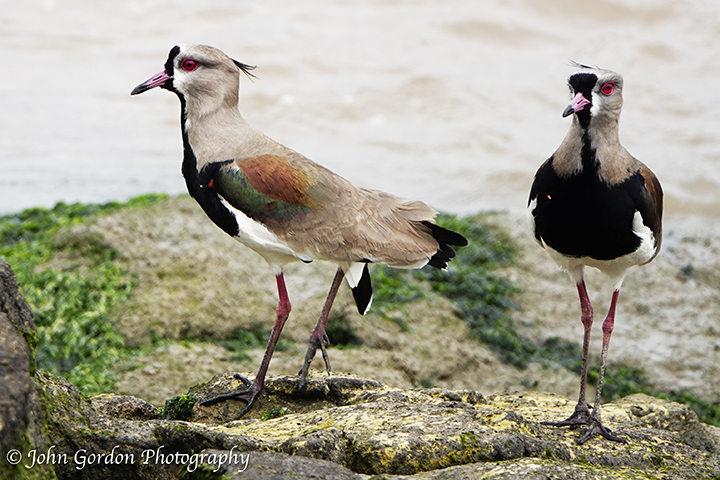
 I checked into the excellent budget priced Palacio Hotel. Close to tourist attractions, it was perfectly situated for a few days break. The family run hotel with its Art Deco features and stained glass was an added bonus. Opening the wooden shutter doors to my oversized private terrace I had my first lifer, an Eared Dove. High above the screeching of a Harris's Hawk drew my attention. There was a plentiful supply of pigeons and doves for them to feast on. Moments later, a second lifer, a Kelp Gull flew past. Before supper a quick walk to the beach turned-up three more lifers, a Neotropic Cormorant, a Southern Lapwing and a White-rumped Swallow. 


Southern Lapwing.

Joining me to bird was Danial Bastaga who some Vancouver birders may know. He now lives in Hungary. Fortuitous having a fellow birder join me as it halved the guiding fee for both of us. Here are a few of the one hundred and fifty species we saw.


Green-barred Woodpecker.

Neither Daniel or myself had birded South America
 so we were happy enough to see and photograph as many birds as possible.

Pampas Fox.

Day one was spent north-east of Montevideo discovering plains, marshlands, estuaries and coastline. Many places were drier than normal which made it harder to find certain wetland species but Mauricio, like any good guide found other locations and other species.

Brazilian Green Racer.

I am as happy going on a birding tour and getting a dozen or so good photographs rather than a photo designated tour where less ground and fewer species encountered. Photographing at feeders is fun for a while but I for one prefer the natural setting as well the chance to scope birds from a long distance. There is something to be said about watching birds behaving naturally.

Many-coloured Rush Tyrant.

The Many-coloured Rush Tyrant is a wetland bird. A skulker and rarely seen in the open.

Red-crested Cardinal.

Quite fearless, this cardinal came down to feed during our lunch break. 

Red-crested Cardinal.

Red-crested Cardinals are members of the tanager family. 
Introduced to other countries such Hawaii, as Puerto Rico, Florida and Japan.

Southern Yellowthroat.

A real skulker, the Southern Yellowthroat is hard to see, rarely sits still and prefers long tall grasses.

Spectacled Tyrant.

The Spectacled Tyrant (male) is a flycatcher found near marshes and wet pastures.

Saffron Finch.

The Saffron Finch is a tanager that is common in open and semi-open areas.


Black and Rufous Warbling Finch.

There Black and Rufous Warbling Finch is another tanager of open scrub. 
Found in the Andes from central Bolivia to NW Argentina. Mostly a ground feeder, 


Grassland Sparrow.

A secretive bird best seen early and late in the day, we were lucky to see this one mid-afternoon.


Glittering-bellied Emerald.

The Glittering-bellied Emerald feeds primarily on nectar. It gets the nectar by piercing the petal bases. with its short, straight bill.

Campo Flicker.

Campo Flickers are found in open habitats such as savannas and grasslands and is often seen foraging in groups.


Great Pampa-Finch.

 The Great Pampa-Finch natural habitats are subtropical or tropical high-altitude scrubland, temperate grassland, subtropical or tropical seasonally wet or flooded lowland grassland and swamps.

Hooded Siskin.

The Hooded Siskin is the most widespread siskin in South America.

Cattle Tyrant.

Cattle Tyrants feed on insects, mostly from the ground. Follows cattle or other large animals, catching flushed prey, or even hitches rides, and then snatching flushed prey with a quick sally-flight.

Rufous Hornero.

 The Rufous Hornero does well around humans habitations (synanthropic)


Rufous Hornero pair and nest (left) and Chimango Caracara.

Rufous Hornero nest.

Scimitar-billed Woodcreeper. 

Unlike most woodpeckers the Scimitar-billed Woodpecker are often found feeding on the ground.

Rufous-capped Antshrike.

A fruit and insect eater, the Rufous-capped Antshrike is an all year round resident of Uruguay.

Blue and Yellow Tanager.

A year-round resident of Uruguay Blue and Yellow Tanagers also breed in Brazil and Chile.


Brown-and-Yellow Marshbird.


The Brown and Yellow Marshbird inhabits wet pastures of far southern Brazil, Uruguay, and northern Argentina. 


Snail Kite

The highly specialized Snail Kite flies on broad wings over tropical wetlands as it hunts large freshwater snails.


 Long-winged Harriers. 


The collared plover is a small shorebird in the plover family, Charadriidae. It lives along coasts and riverbanks of the tropical to temperate Americas, from central Mexico south to Chile and Argentina. 

Giant Wood Rail.

The Giant Wood Rail is native to South America, with its range extending across eastern Bolivia, east-central and southeastern Brazil, Paraguay, Uruguay, and northeastern Argentina.


Southern Screamer.

Southern Screamer bond for life. Nests are built in marches where it feeds on grasses, seeds and plant material.

Burrowing Owl with frog.

The very last birds we saw were at Colonia Wilson. An area of greenhouses, farmland and park. We had thirty-two species including Short-eared owl. The very last birds, a pair of Burrowing Owls were happily nesting and seemingly doing well beside a road in the middle of a small village. Their burrow right next to a pathway. We found this pair and shot from the car window until traffic forced us to move on. A great way to end our three days birding with Mauricio. 


Tour guide
-- 
Florencia Ocampo 
Director / Tour Leader
Birding With Me - Birdwatching Tours
birdingwithme.com
Montevideo, Uruguay

Connect with us on social media!
Instagram: @birdingwithme
Facebook: birdingwithme